Big Tech must tackle scourge of scam adverts, says Ofcom
10 Jul 2026 01:13 PM
Big Tech will be held accountable for tackling scam ads on their platforms, under proposed new fraud-fighting rules announced today by Ofcom
- Ofcom calls for crackdown on fraudulent adverts online and sets out nearly 40 new safety measures for major sites and apps to adopt
- Rules include banning accounts that post scam ads and making them easier to report - firms “should not drag their heels” and improvements can start now
- Anti-fraud drive part of wider new requirements for the biggest online platforms
Today’s proposals on tackling paid-for scam adverts further implement the Online Safety Act and will apply to some of the UK’s most widely used sites and apps- including social media and search platforms - in line with criteria set by Government [1].
More than £40billion a year is spent on digital advertising across the UK, making up the majority of the revenue earned by the tech giants selling the ads.
But tech firms haven’t done enough to protect people from cybercriminals who use their platforms, and scam adverts can have devastating consequences for victims, including financial loss and emotional distress.
Over half (51%) of adults have encountered potentially fraudulent ads online, with over a third (36%) seeing them frequently [2]. An estimated total of over £200million is lost by victims to these kinds of scams in the UK on average each year [3].
Ofcom’s draft fraudulent advertising code, published today, means Big Tech will for the first time be legally required to put robust measures in place to address scam advertising, when it comes into force [4].
Ofcom’s work is part of a wider effort to tackle fraud, the UK’s most commonly experienced crime. Fraud may start online before moving elsewhere, and we are working closely with partners like law enforcement, business, and organisations that represent consumers [5].
Ending the ad fraud free-for-all
Our ambitious draft code sets out nearly 40 new practical measures for how major platforms should protect their users from falling victim to scammers. Our expectations include:
- banning bad actors who post scam ads and preventing perpetrators from creating new accounts;
- intercepting imposters who pretend to represent legitimate businesses by checking that people setting up new advertising accounts work for who they claim to;
- foiling financial fraudsters by ensuring that anyone posting an ad for banking or investment services is legally allowed to, such as by being registered with the Financial Conduct Authority;
- stepping up security safeguards to lessen the risk of accounts being hijacked;
- combatting criminals who exploit AI advert-making tools to create scam content, by rigorously testing them to reduce the risk of misuse; and
- empowering trusted bodies, like law enforcement, by setting up a dedicated channel for them to flag scam ads, which must then be swiftly removed.
We also want to see proactive technology used to filter out fraudulent ads at source, and will bring forward a separate consultation on detailed proposals in autumn this year alongside a broader package of new safety measures to further bolster our online safety work.
Our consultation on today’s proposals is open for feedback until 2 October, and taking responses into account, we will set out our final decisions next year.
We are clear, however, that platforms do not need to wait for our new measures to focus more investment and senior attention on protecting people from scam ads.
Once approved by Parliament, our Codes will come into effect and companies who fall short can be subject to enforcement action – including fines of up to £18million or 10% of global revenue, whichever is greater.
Oliver Griffiths, Ofcom’s Online Safety Group Director, said: “For too long, victims have been exposed to scam ads online with tech giants simply not doing enough to combat the fraudsters using their platforms.
“Today we’ve set out nearly 40 practical, protective measures for companies to adopt. We expect firms to take robust action to stamp out scam ads and boot out the bad actors behind them to safeguard their users
“Platforms should not drag their heels – they can start making improvements for their users now. And sites and apps that fail to meet their legal duties, once in force, can expect to face serious consequences.”
Nick Sharp, Deputy Director of the National Economic Crime Centre, said: ‘’Fraud continues to cause significant harm to individuals and businesses across the UK, with criminals increasingly exploiting online platforms and their advertising infrastructure to reach victims.
“We welcome Ofcom’s consultation on the Fraudulent Advertising Duty under the Online Safety Act and the opportunity to strengthen collective efforts to prevent fraudsters from using online services to facilitate criminality.
“Effective collaboration between regulatory, industry and law enforcement organisations is critical to protecting the public and reducing fraud-related harm.’’
Steve Smart, executive director lead for fighting financial crime at the FCA, said: “We support Ofcom’s proposals for cracking down on online fraud which has a devastating impact on victims and undermines the financial system.
“Tech firms must do more to proactively prevent scam adverts targeting UK consumers and businesses. They don’t have to wait for these new rules and should step up now.”
Additional duties for platforms
Separately, we have today published a broader set of draft rules under the Online Safety Act to make firms more accountable and give their users more control over their experience online.
These will also apply to the some of the most widely used platforms - such as Facebook, TikTok and Snapchat - known as ‘Category 1 services’, based on criteria set by Government [6].
For these services, there are a range of new requirements, including:
- Protecting news, journalism and content of democratic importance. Freedom of expression is a cornerstone of our society and must be respected online. Today’s draft guidance will help safeguard news and journalism and give media organisations more of a say when platforms seek to moderate or remove their content. And we’re proposing new measures to ensure sites and apps take more care with content that matters most in a democracy, like journalistic content and political debate.
- Giving adult users more control. The law already requires services to tackle illegal content, and to protect children from content that is harmful but not criminal. We’re now proposing platforms give adults tools to help keep suicide, self-harm, eating disorder, hateful or abusive content out of their feeds. Alongside this, people must be given the choice to filter out content from, and prevent their own posts being seen by, accounts that haven’t been verified. Taken together, these measures will help people guard against distressing and disturbing content online.
- Being more accountable. We expect sites and apps to have clear and accessible rules for users, and stick to them. And when something is wrong, complaining should be easy and straightforward.
In addition, these platforms will face greater scrutiny by being required to publish a summary of their assessments of the risks of illegal content and harms to children on their services and be more transparent.
The consultation on these measures closes on 2 October, and our final decisions will be published next year.
Notes to Editors
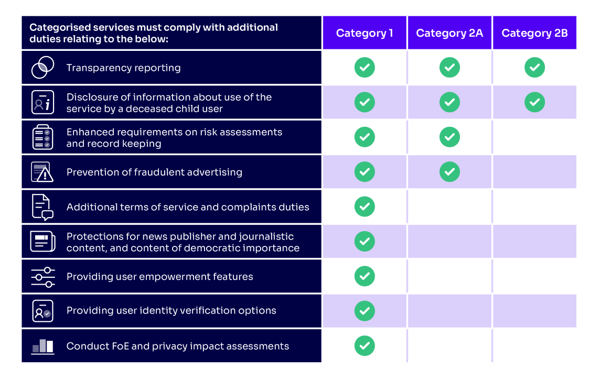
- The duties on fraudulent advertising will apply to platforms that fall into Category 1 or Category 2a on the Register of Categorised Services. In practice that means social media and search platforms that pass certain thresholds for UK user numbers, functionalities and characteristics, in line with criteria set by Government.
- Statistic refers to 51% of adults who are online having seen a potentially fraudulent advert on social media, search services and video-sharing platforms. Source: Ofcom Online paid-for advertisements.
- Source: Further Detail on Economic Assumptions and Analysis.
- The measures set out today build on existing legal duties for all platforms in scope of the Online Safety Act, which are already in force, to tackle fraudulent content where it isn’t part of a paid-for advert.
- Source: National Crime Agency.
- Categorisation – key context:
- The Online Safety Act specifies that there will be additional legal duties for ‘categorised services’.
- There are three categories. The criteria for determining whether a platform falls within one these categories relates to a service’s user numbers, functionalities and characteristics.
- These criteria were set by Government in secondary legislation, and Ofcom’s role is implementation.
- In line with the Act, sites and apps in Category 1 are subject to a range of additional duties. Smaller sets of additional duties will apply to platforms in the other two categories.
- Category 1 is user-to-user services that either have: (1) 34 million UK users and a content recommender system, or (2) 7 million UK users, a content recommender system and the ability for users to share/forward content.
- Category 2a is search services – i.e. a search engine or a site or app with a search function that can pull results from a range of sources – with over 7 million UK users.
- Category 2B is user-to-user platforms that allow users to send direct messages and have more than 3 million UK users.
- We have today also published the Register of Categorised Services.
- The duties that apply to each category can be seen here: