Charity Archives and Records Now
26 Aug 2026 02:43 PM
On 13 May 2026, the British Academy hosted Charity Archives and Records Now, a one-day event exploring new directions in research, policy and practice.
In 2022, The National Archives launched the Charity Archives Development Plan, alongside a steering group of key stakeholders. This strategic initiative was designed to improve the preservation, visibility and long-term sustainability of charity archives across England.
One of the key objectives of this initiative was the completion of an Arts and Humanities Research Council-funded collaborative doctoral degree by Paul Beard. This research was supervised by The National Archives’ sector leadership team and academics at University College London through our collaborative PhD programme.
In May 2026, Paul Beard presented findings from his doctoral research at The Charity Archives and Records Now event, which for the first time, provided robust evidence about the current state of voluntary sector archives in England. The event was hosted by the British Academy. It was organised by Georgina Brewis and Angela Ellis Paine as part of their British Academy Research Project Archiving the Mixed Economy of Welfare.
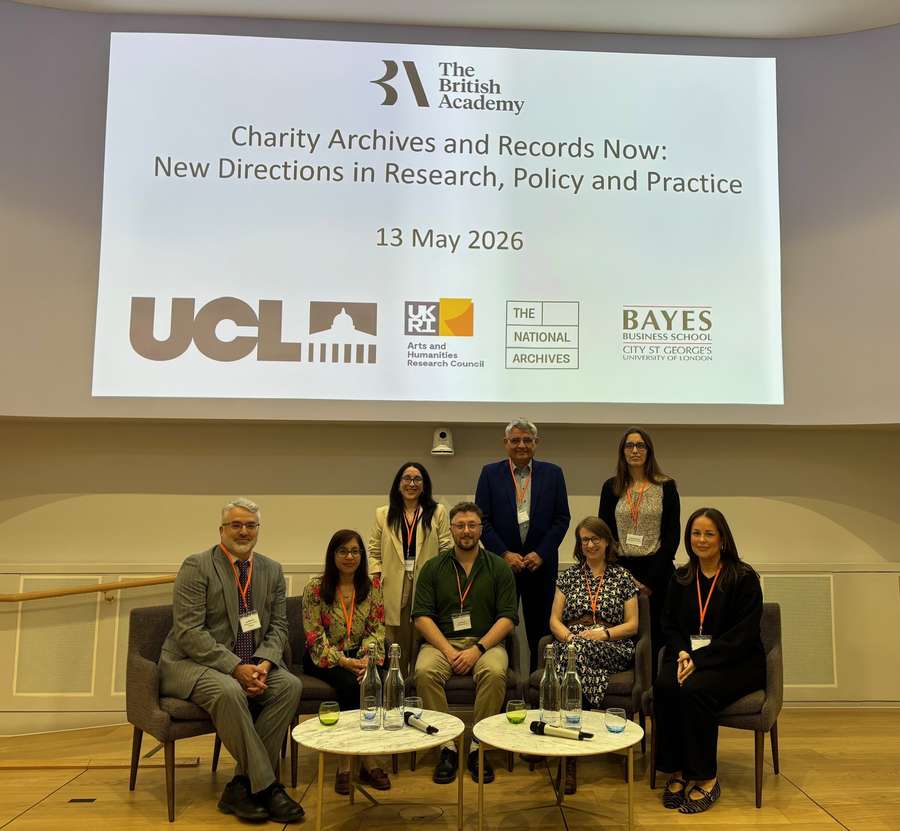
Top Left to Right: Daniella Gonzalez, Archivist, Islamic Relief; Saul Nassé, Chief Executive and Keeper, The National Archives; Angela Ellis Paine, Lecturer in Voluntary Sector Management, Bayes Business School. Bottom Left to Right: Jay Kennedy, Director of Policy and Research, Directory of Social Change; Mazeda Alam, Head of Guidance, The Charity Commission; Paul Beard, Records Manager, The Salvation Army; Georgina Brewis, Professor of Social History, University College London; Kathryn Preston, Sector Development Manager: North West & Charities, The National Archives.
Paul Beard’s research questions the extent to which voluntary sector records should be seen as at-risk, concluding that there has been considerable progress in this area since the 1990s. Many charities are now leading the way in innovative archival and record keeping practice. However, the research also shows there is a strong appetite for further support and guidance. Paul identifies four key policy challenges:
- In England, there is a complicated and confusing legal and regulatory framework that is unclear on what the record-keeping expectations for charities are.
- There are considerable inequalities in terms of access to records due to few legal protections outside of the Data Protection Act 2018.
- The guidance and advice available to charities differs between public agencies, infrastructural bodies, and professional associations. In some cases, published guidance and advice documents are contradictory.
- There is limited capacity in charities to improve or implement professionalised record-keeping.
The British Academy invited a panel of leaders from both the archives sector and the voluntary sector to respond to these challenges.
Mazeda Alam, Head of Guidance at the Charity Commission, highlighted some of ways in which poor recordkeeping might land a case on her desk. She acknowledged that there was value in shifting from a focus on compliance to one which values archives as strategic assets for charities.
Indeed, Islamic Relief archivist Daniella Gonzalez made a compelling case for seeing archives as assets. Daniella drew on her own experience to show how an organisational archive can support current priorities, including in marketing, fundraising and policy work.
Jay Kennedy, from voluntary sector infrastructure body Directory of Social Change, confirmed the importance of record keeping as part of good leadership. Jay highlighted the demand for simple guidance such as their new note on Minute Taking.
Our Chief Executive, Saul Nassé, welcomed Paul’s recommendations. He committed to continuing support via existing initiatives including the Charity Archives Development Plan and the 2026 Government vision for archives, Archives at the Heart of Society.
The day also included three interactive workshops. Simon Wilson and Kevin Bolton ran a session exploring how to manage digital records. This drew on our recently published guidance: Digital record keeping in the voluntary sector. British Red Cross Archivist Stephen Noble led a discussion on how to make the most of your charity’s archive. Georgina Brewis and Angela Ellis Paine ran an interactive role-play exercise about interdisciplinary research using charity records. This was based on their Economic and Social Research Council-funded project Discourses of Voluntary Action. This has been published as a short book and is now freely available via open-access: Transformational Moments in Social Welfare - What Role for Voluntary Action?
The archival scholar Anna Sexton opened the final panel by explaining the key principles of person-centred approaches to records management and archiving. Person-centred approaches shift the discussion from a focus on records to the people that create, keep, use or are represented in records. Anna noted how charities such as the Care Leavers’ Association, Coram and Family Action are leading the way in this significant new field of practice and scholarship.
This was reinforced by Megan Parker, the head of Barnardo’s archive, who argued that records can be important tools for social justice. Megan recommended that the audience watch the BBC TV series Alma's Not Normal for an insight into the impact receiving records might have on individual care leavers.
From a research perspective, Joanne Hogarth Raineau highlighted that researchers can also experience trauma from working with difficult archival material. Joanne proposed that greater attention should be paid to this topic. Philip Milnes-Smith presented an archives sector perspective on person-centred approaches. Philip noted how archive services need to remain aware of the potential power imbalance with donors and depositors. Services should be asking ‘whose records are we getting?’ and ‘who is still going unrecorded?’
The Charity Archives and Records Now event was a moment to celebrate the many positive developments in this field. It also offers the chance to renew the sector’s commitment to collaborative work. This can truly ensure that the charity and voluntary archive sectors and the achievements they preserve represent ‘a proud part of our national identity’ (Civil Society Covenant, Department of Culture, Media & Sport, October 2025).