LNER tops ORR passenger assistance rankings as demand rises 18%
17 Nov 2026 11:06 AM
London North Eastern Railway (LNER) has been ranked Britain’s best-performing operator for passenger assistance in ORR’s latest assessment, as demand for support continues to rise.

Body
Components
LNER was one of 15 operators assessed by ORR on the reliability of the assistance they delivered and passengers' satisfaction with the support they received.
The findings come as demand for Passenger Assist continues to grow, with requests for assistance increasing by 18% across Britain during 2025-26.
Southeastern, Network Rail, Chiltern Railways and Greater Thameslink Railway also scored highly this year, while West Midlands Trains was the lowest ranked, followed by Northern Trains, Transport for Wales and South Western Railway.
Northern, West Midlands Trains and South Western Railway were also among the poorest performers for reliability in last year's report (covering 2022-2025). In response, ORR required West Midlands Trains and South Western Railway to develop improvement plans, alongside its ongoing work with Northern. All three have since started to make improvements to their service, and ORR will continue to monitor their progress.
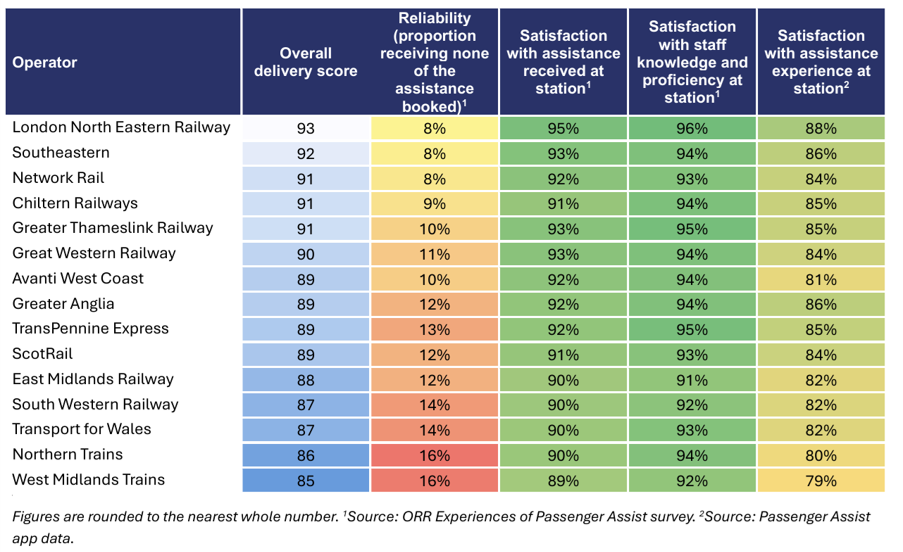
ORR’s assessment has also examined staff knowledge and proficiency and, for the first time, incorporated passenger feedback submitted through the Passenger Assist app. The assessment looks at performance over a three-year period (2023-2026).
Passenger satisfaction with assistance remains generally high, but ensuring passengers consistently receive the support they have booked remains a challenge.
ORR has continued to focus its monitoring and engagement on the poorest performers from last year’s report in order to achieve sustained improvements.
ORR has also raised concerns with Avanti West Coast, after it recorded the largest year-on-year deterioration in reliability. The proportion of surveyed passengers who received none of the assistance they had booked rose from 9% in 2024-25 to 12% in 2025-26.
Stephanie Tobyn, ORR’s director of strategy, policy and reform, yesterday said:
“The best-performing operators are showing what good passenger assistance looks like. But every passenger who books assistance should have confidence that the help they need will be there when they need it. When that support fails to arrive, it can seriously undermine their confidence to travel.
"With demand for assistance continuing to rise, operators must make sure their services keep pace. Where performance falls short, we'll continue to challenge operators and hold them to account."
Notes to Editors
- The 2026 benchmarking report assesses 15 train and station operators using three years of passenger feedback, weighted towards the most recent year. The overall delivery score is based on reliability (50%) and three passenger satisfaction measures (50% combined).
- The 2026 assessment uses a broader methodology than the 2025 report, which ranked operators on reliability alone. The overall rankings are therefore not directly comparable between the two years, although individual reliability measures can be compared.
- All train and station operators must establish and comply with an Accessible Travel Policy (ATP) as a condition of their licence, setting out their provision for disabled people. Operators must secure ORR approval for their ATP, and we have issued guidance that defines minimum requirements, covering areas such as provision of assistance, staff training and passenger information. Passengers may either book assistance in advance (up to two hours ahead of the journey) or ‘turn-up-and-go’ (TUAG). Passenger Assist is a service provided by train companies to passengers who require help with their train journey.
- The Office of Rail and Road (ORR) is the independent economic and safety regulator for Britain's railways and monitors the performance and efficiency of England's strategic road network. ORR also protects the interests of rail passengers through its consumer and accessibility work.
Related links
Benchmarking operators’ performance in rail passenger assistance: 2026 report