Native crayfish population survives following major incident
10 Feb 2026 03:43 PM
Intensive surveys by the Environment Agency has found the native white clawed crayfish population in Northumberland has survived a major incident.
In autumn 2024 around 100 of the endangered native species were found dead in the River Wansbeck catchment – a nationally significant population.
The subsequent investigation determined crayfish with similar symptoms – unusual orange patches on their shell displaying as ulcers or lesions – were widespread across the Wansbeck catchment as well as areas of the neighbouring rivers Tyne and Blyth catchments.
A series of summer surveys during 2025 took place to try to identify the cause of the symptoms as well as understand the impact on current populations and mortality rates.
In total, the Environment Agency and National Trust have carried out 76 surveys since the deaths were first reported.
The main findings of the investigation are:
- The symptoms do not appear to be fatal at a population level.
- It appears some, particularly younger crayfish, can recover from the visual symptoms via the normal moulting process.
- Many with symptoms can live with them – some that had symptoms in autumn 2024 are still alive now.
- Others do not develop symptoms despite living with affected crayfish.
- The mortalities – which happened during a natural moulting period - seemed to occur more frequently in older and larger crayfish where the symptoms appear to interfere with the moulting process.
- There is a reduction in instances and severity of the symptoms that were first observed in autumn 2024.
- There have been no further reports of native crayfish deaths in any catchment since autumn 2024.
Further research into the cause of the symptoms is still being carried out by the Centre for Environment, Fisheries and Aquaculture Science (Cefas) and Dr Jamie Bojko, Associate Professor in Disease Ecology, who runs the Tees Animal Pathology lab at Teesside University.
The Tees Animal Pathology Lab is at the University’s multi-million pound research institute, the National Horizons Centre.
The exploration has identified a series of known and novel associations with the affected crayfish, but the exact reasons for the emerging symptoms remain unclear.
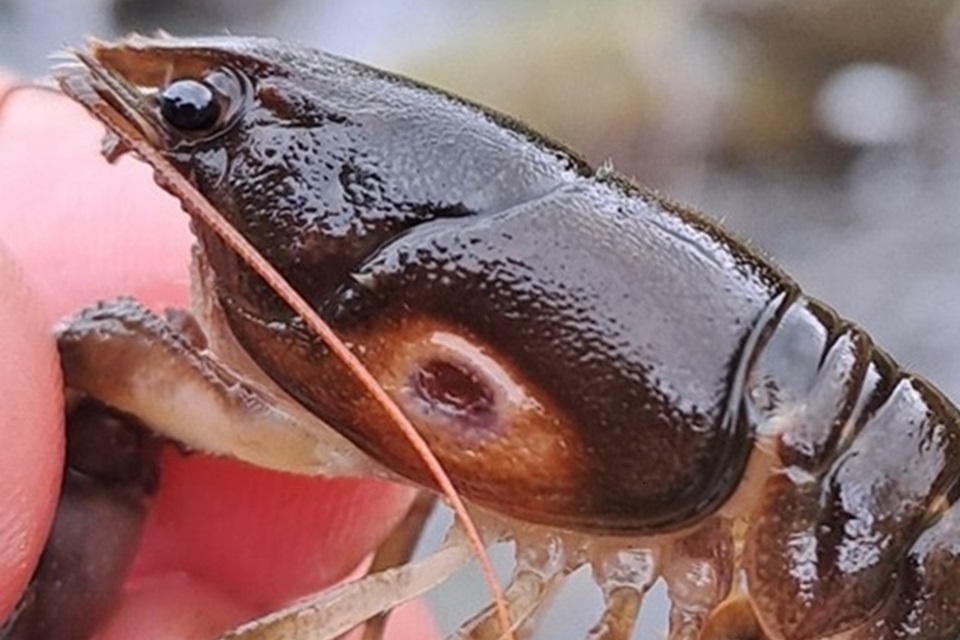
Image shows symptoms on the native crayfish.
‘Not all crayfish affected’
Sarah Jennings, Area Environment Manager at the Environment Agency yesterday said:
The River Wansbeck supports one of the highest density populations of white clawed crayfish in the world, and when the initial deaths were reported we were concerned this could have a devastating impact.
While it’s too early to tell what the long-term implications are for the Wansbeck population, there are hopeful signs that the impact is limited and it will remain a stronghold for the species.
Our studies show that not all crayfish in the population are affected, and some can recover from or live with the symptoms.
There’s still some research ongoing to try to understand what it is that’s causing the issue, but it could be something we never fully understand.
Our focus now is to work with partners and use our new knowledge to continue conservation efforts and safeguard the future of this important species.
Ongoing research will help identify if external factors that cause stress to a population – such as drought or heatwaves for example – are a trigger for future outbreaks.
Conservation work continues
The Environment Agency’s focus is to continue work with partners to further important conservation work, such as increasing the number of safe ‘ark’ sites.
Ark sites are water bodies that are isolated from the risks commonly affecting white-clawed crayfish where they can live and breed.
Following the deaths the Environment Agency joined forces with partners at the National Trust and Northumberland Zoo to rescue visibly healthy crayfish from the River Wansbeck at the Trust’s Wallington Estate.
Females carrying eggs – known as ‘berried’ females – were kept in tanks at the zoo, which has the facilities to rear the young.
The berried females’ eggs hatched in April 2025 and the offspring will be released into ark sites later this year.
The public and especially river users are being urged to continue to follow Check, Clean, Dry advice to prevent any spread of symptoms:
- Check clothing and equipment for mud, aquatic animals or plant material. Remove anything found and leave it at the site.
- Clean everything thoroughly as soon as possible, paying attention to areas that are damp or hard to access and using hot water if possible.
- Dry for at least 48 hours, or if this is not possible use a suitable disinfectant before using elsewhere.
More information on check, clean, dry can be found on the invasive non-native species website.
If people see any crayfish, alive or dead, leave it where it is and report it immediately to the Environment Agency on 0800 807060. It is illegal to handle or remove crayfish from the water without the correct licences.
Background information
Symptoms:
- The symptoms seen in crayfish includes unusual orange patches on their upper shell and in some cases opaque-white muscles in the tail.
- Abnormalities such as missing rostrums or stunted claws ad deformities to the outer carapace of the crayfish, such as blisters.
White clawed crayfish:
- The endangered white-clawed crayfish are the UK’s only native, freshwater crayfish. They play a vital role in keeping our waterways clean and as a source of food for other native species.
- They have struggled to survive since the increase of the invasive American signal crayfish in the 1970s. The signals spread crayfish plague, which isn’t harmful for them but is fatal for the native species and are also bigger and out-compete the white clawed crayfish.
- There are no known signal crayfish in the River Wansbeck catchment and crayfish plague was ruled out as a cause for the River Wansbeck mortalities.
- Breeding takes place in autumn and ‘berried’ females can carry around 80 eggs through winter and spring. These hatch into juveniles in early summer.