One Year On: The Aftermath of the Kabul Evacuation
15 Aug 2022 02:38 PM
The US policy errors which led to the chaotic exit from Afghanistan were only surpassed by Pakistan’s blunder in championing the Taliban and the much more dangerous Haqqani group. The Haqqanis are now holding Afghanistan hostage. So far, regional powers are still trying to engage with the Taliban – but for how much longer?
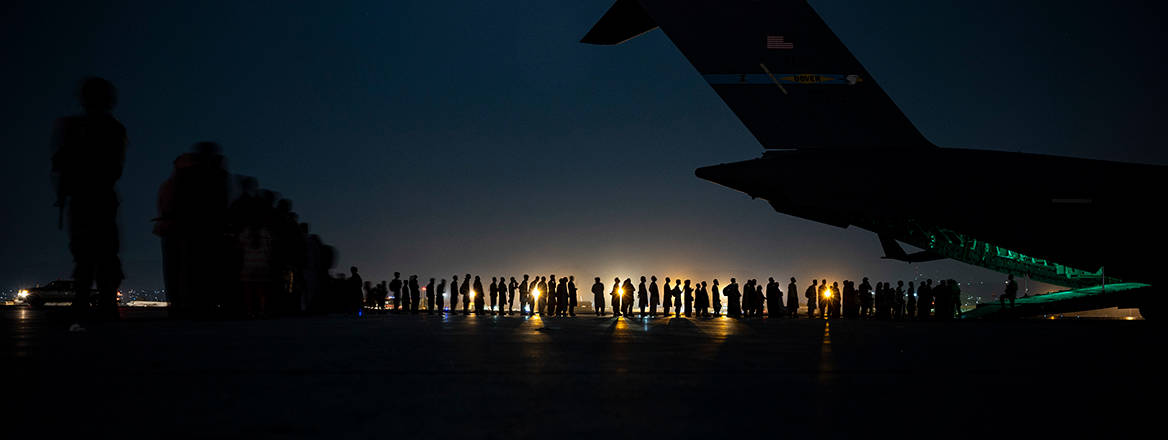
The memories of August 2021 are still raw. The refugees falling from C-17 transport aircraft and queuing waist-deep in sewage will remain lasting images, along with the drone strike on an innocent family and the billions of dollars of military equipment left behind. But how does the local situation look now?
Nearly a year later, a recent CIA operation killed Ayman al-Zawahiri, the head of Al-Qa’ida, who was allegedly staying at a house linked to Sirajuddin Haqqani in the Sherpur district of Kabul. This event indicates three important points.
- As predicted, the terrorists hiding in Waziristan on the Afghanistan–Pakistan border have returned to Afghanistan for the first time since late 2001. This was exactly what Western leaders claimed would happen when they justified the NATO presence for 20 years. The UN has recently reported that the Afghan branch of Islamic State is one of ‘the most vigorous and best established’ of its regional networks.
- The Haqqanis, who have long been close to the Al-Qa’ida leadership, have not changed their spots. They lead a terrorist organisation which is both distinct from and part of the Taliban. They are (or should be) the biggest barrier to countries considering whether to discuss recognition with the traditional Kandahari Taliban, led by the more moderate Mullah Baradar.
- Although CIA drones were evidently able to mount an operation in Kabul, the fact remains that Western counterterrorist capabilities in Afghanistan are insufficient for the extent of the threat. Zawahiri was an iconic target rather than a major threat, and the US must have been operating at the limit of its capabilities.
The removal of the Haqqanis from Afghanistan is an ambition which would unite most regional powers as well as the Kandaharis. However, it is difficult to see how it could possibly happen, even if the support of Pakistan could be secured. The Haqqanis control Kabul, are heavily armed and intend to stay.
Within weeks of the Taliban takeover, Islamabad had good reason to recognise the extent of its mistake in championing them
Indeed, the events of the past year have been a disaster for Pakistan. Within weeks of the Taliban takeover, Islamabad had good reason to recognise the extent of its mistake in championing them. Pakistan had three objectives which it wanted the Taliban to deliver.
- It wanted to keep the Indians out of Afghanistan. But India, instead of sponsoring opponents of the Taliban, has decided to engage with Kabul. New Delhi has provided vital food aid to a country in real need. It has also subtly played on the Kandahari Taliban’s traditional dislike of Pakistan. Mullah Yaqub, the Taliban defence minister, has even suggested military training in India.
- The Taliban and the Haqqanis were expected to facilitate the destruction of the Pakistani Taliban (TTP) and hand over wanted terrorists to the Pakistani army. The Haqqanis soon made it plain that they could not (and would not be able to) comply. They argued that the Kandaharis were often from the same villages as the TTP and were blocking cooperation. Instead, the Pakistani army has had to engage in complex ceasefire talks with the TTP.
- The new Afghan government was supposed to recognise the 1897 Durand Line as the international border. Pakistan had erected a wire fence at considerable expense in recent years, but within weeks the Taliban and TTP were cutting the wire and renewing claims to Pashtun areas of Pakistan.
It appears that Pakistan’s Chief of Army Staff, General Qamar Bajwa, had already nursed anxieties about a Taliban takeover, but he was opposed by his intelligence chief Faiz Hamid and by the powerful Corps Commanders. China, too, had expressed concerns about Islamabad championing a Taliban-only (rather than a more broad-based) government, but Beijing did not push its case.
The West should not recognise Afghanistan while the Haqqanis control Kabul, and will not while the Taliban refuse to allow female education
Now, one year on, China is worried. The Taliban and Haqqanis show no interest in handing over Uighur militants to the Chinese authorities. There are concerns in Beijing that Uighur extremists may have started collaborating with Balochi groups and the TTP to undermine the China–Pakistan Economic Corridor. There have been a number of attacks inside Pakistan in which Chinese citizens have been targeted, including the bomb blast in Quetta in April 2021 which the Chinese Ambassador narrowly escaped. A year later, a Balochi suicide bomber killed three Chinese citizens near Karachi’s Confucius Institute. This has led to a renewal of Chinese pressure to deploy their own security to Pakistan – a demand which Pakistan has repeatedly refused.
Iran is another country which has sought to engage with the Taliban. Its embassy in Kabul has remained open, and it is watching carefully to see how the Taliban treats the large Shia minority in the country. Like China, it is relieved to see the back of NATO, and like India, it appears to have decided – for the moment – not to support the armed opposition group of Ahmed Massoud which operates close to the Tajikistan border. No country yet has an appetite for renewed civil war in Afghanistan.
That includes Russia and the Central Asian Republics (CARs), which still look to Moscow for Afghan policy as part of the Commonwealth of Independent States alliance. Russia established direct contact with the Taliban in 2017, but is still deeply sceptical of Taliban intentions and concerned about the spread northwards of weapons, religious extremism, terrorism and opium, and their ability to destabilise the CARs. Meanwhile, all plans for pipelines and railway lines across Afghanistan depend on recognition of the Taliban by the international community, and on peace.
And there lies the central conundrum. The West should not recognise Afghanistan while the Haqqanis control Kabul, and will not while the Taliban refuse to allow female education. Until recognition, nothing can progress apart from humanitarian aid. Meanwhile, all that the international community – which now has other more pressing concerns – can do is try to prevent terrorism and drugs being exported from Afghanistan. That same policy failed between 1989 and 2001, and doubtless will fail again.
The views expressed in this Commentary are the author’s, and do not represent those of RUSI or any other institution.
Have an idea for a Commentary you’d like to write for us? Send a short pitch to commentaries@rusi.org and we’ll get back to you if it fits into our research interests. Full guidelines for contributors can be found here.