Portfolio thinking – getting the recipe right
9 Mar 2022 01:49 PM
Blog posted by: Emma Willson, 07 Mar 2022.

If I weren’t an auditor, my dream job would be to run a small fish restaurant on the coast. Cooking is a passion, and surely buying a few good-quality ingredients to create a meal cannot be too hard? But given the number of restaurants that shut down, it is obviously a more complicated and risky endeavour.
To be successful, aspects such as front-of-house and cleaning need to come together; you will need to understand and adapt your menu to customers’ wishes; decide where to invest (décor or people?); and be clear about the value your restaurant adds above the competition.
If preparing the meal is a project, with clear parameters, the complexities of running a restaurant mean portfolio thinking is needed to bring everything together and manage the risks.
The benefits of portfolio thinking
Government departments are increasingly being asked to deliver complex and broad ‘menus’, such as net zero, devolution and levelling up. To do so, they must bring together programmes, projects and wider activity into portfolios likely to span multiple departments, take many years and have a broad impact on society.
Through the National Audit Office’s (NAO’s) work auditing government programmes, we have seen the value of portfolio thinking in helping achieve an overarching aim. It can provide:
- a shared understanding of an objective across decision-makers, practitioners and stakeholders;
- a whole-system and longer-term perspective to help understand the totality of change required to meet an objective;
- an understanding of the aggregate risk, so it can be assessed against the risk appetite and tolerance of an organisation; and
- complete and comparative information to help consider all the activities within the portfolio and make effective decisions.
Some previous recipes
We have seen the value of portfolio thinking where government formally defines a portfolio ‘following a recipe’. An example is the Ministry of Defence’s portfolio of 32 programmes designed to provide capabilities to meet the strategic requirements underpinning the UK’s defence policy.
It can also be valuable where activities have not been formally prescribed as a portfolio. The former Department for International Development looked to achieve the goals outlined in its 2018 Strategic Vision through programming and influencing activity. Following underlying principles – such as understanding what customers want, keeping track of costs to understand where you can make money and take risks, and securing products and services from a reliable supplier – can be equally as effective.
Opportunities to use portfolio thinking to structure government activity may easily be missed. For example, we noted the need for consistent portfolio-wide data in our reports on UK Research and Innovation’s management of the Industrial Strategy Challenge Fund and the Department for Business, Energy & Industrial Strategy’s administration of Business Support Schemes.
As government continues to instigate broad, cross-organisational outcomes, the need to consider a portfolio approach will become more relevant.
Our cookbook
Our recently published framework for portfolios sets out the value of portfolio thinking and, drawing from our work, provides insights and questions to assess its effectiveness. It shares questions you can ask yourself to check you are on the right lines, with 16 examples from published NAO case studies to illustrate the points. We draw together insights and questions across six areas:
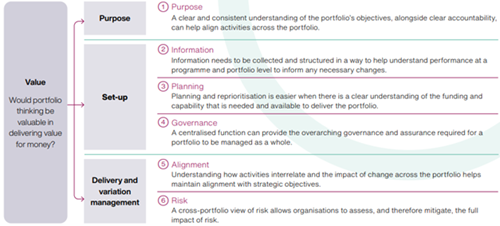
Picking up a few of these, our framework outlines how:
- collecting and structuring information can help understand performance at a programme and portfolio level to then make any changes. Can you negotiate better deals from suppliers by pulling together ingredients for each dish into a collective shopping list? Could you gauge the impact of not serving certain dishes on, for example, the wine list sales?
- planning and reprioritisation can be easier through having a clear understanding of what funding and capability is needed and available. Can you get the right ingredients at the right cost, or are they out of season? Do you know the skills needed and what the sous-chefs can do?
- having a centralised function can help provide the overarching governance and assurance required. Does a head chef coordinate the sous-chefs, making clear who does what and when? Is it clear who will decide whether to invest in the expensive wine or ingredients?
Final thoughts
Government recognises the value of a structured portfolio and what is required to get this right. The Infrastructure and Projects Authority recently published standards for departmental portfolios and is reviewing departments’ approaches. This aims to help departments, for example, monitor and respond to risks across the portfolio and build the right culture.
As government looks to be more ambitious, with aims and portfolios expanding beyond departmental boundaries, it must think carefully about the experience it wants for customers, how much to invest and how it will bring everything together.
Hopefully our framework for portfolios provides a useful tool for you to step back and question whether the basics have been done correctly.
Further reading
About the Author
Emma Willson
Emma Willson is Major Project Delivery Hub Director at the National Audit Office