TV broadcasters must maintain momentum on diversity
28 Sep 2018 11:29 AM
UK television broadcasters are collecting more data on the make-up of their workforces than ever before, Ofcom has found, marking a step forward in understanding and addressing under-representation across the TV industry.
- Television industry improves picture of its workforce over the year
- Industry leaders spearhead work to promote diversity and inclusion
- But disabled people and minority ethnic employees remain under-represented
Last year, Ofcom required broadcasters to undertake more regular and detailed monitoring of employees’ characteristics, to identify under-represented groups and help tackle a lack of diversity in UK television.
Yesterday’s report, Diversity and Equal Opportunities in Television 20181, examines progress over the last 12 months across the UK-based TV industry. It focuses on the five main broadcasters – the BBC, Channel 4, ITV, Sky and Viacom (which owns Channel 5).
Having a more representative workforce helps broadcasters to create innovative, imaginative and authentic television that reflects modern Britain and the lives and experiences of their whole audience. Broadcasters have an obligation, as a condition of their licences, to take measures to promote equality of opportunity in employment. This also helps people to work in broadcasting who otherwise might not have a chance to do so.
Better data, but gaps remain
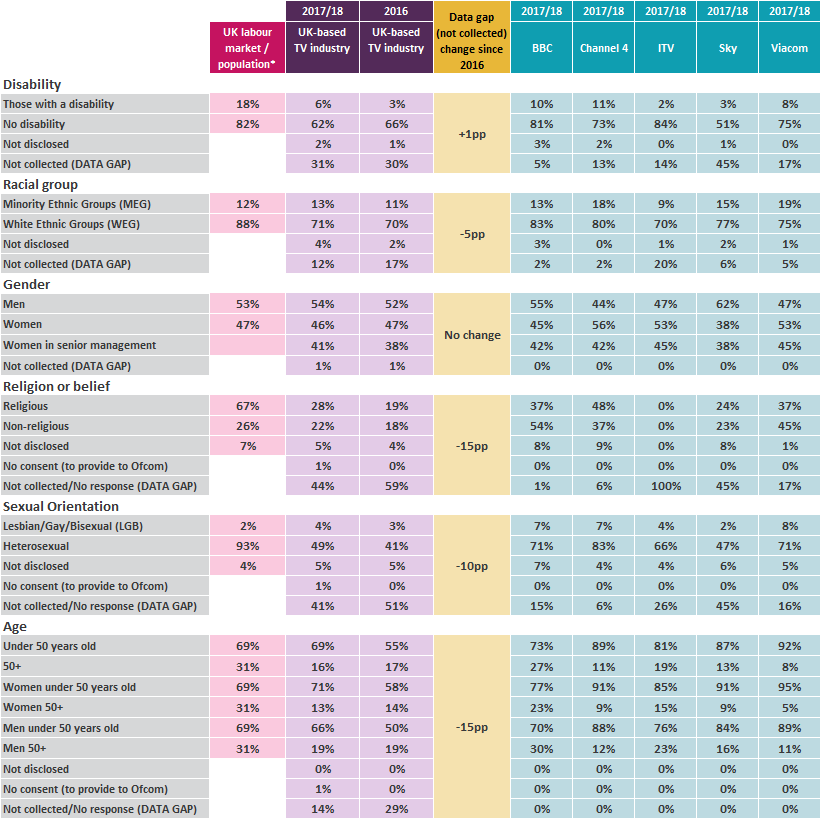
Taking the UK-based television industry as a whole, TV broadcasters now collect data on the ethnicity of 88% of staff, up from 83% last year. They have measured the age of 86% of employees, and the sexual orientation of 59% – up from 71% and 49% respectively a year ago. The religion or belief of 56% of staff is also captured in yesterday’s report, up from 41% a year ago.
But information on the disability status of employees has failed to improve, with 31% of staff (11,323) unaccounted for – similar to last year. As a result, the picture of how well disabled people are represented in UK television remains unclear.
Ofcom expects broadcasters to keep improving data, particularly in areas such as disability and sexual orientation, and the monitoring of freelance staff,2 where it remains poor. We will be working with broadcasters to help them address this in the coming months.
Much more to do on diversity
- Disabled people remain significantly under-represented. The proportion of employees who define themselves as disabled has doubled from 3% to 6%. But this remains far below the UK population average of 18%. Of the five main broadcasters, Channel 4 (11%) and the BBC (10%) have the highest representation of disabled people, followed by Viacom (8%). Sky (3%) and ITV (2%) have the lowest.
- Minority ethnic representation yet to improve at senior levels. The proportion of employees from minority ethnic backgrounds has risen slightly from 11% to 13%, which is in line with the UK workforce average of 12%.3 But representation at senior management level (8%) has seen no significant improvement since last year (7%). Minority ethnic employees are also under-represented in content and creative roles at all the main broadcasters, exceptfor Viacom.4
- Small increase in women at senior levels. Overall,women in the TV industry (46%) are represented broadly in line with the UK’s working population (47%). Sky employs fewer women (38%) as a proportion of its workforce than the other main broadcasters.5 The proportion of women at senior management level across the industry has increased from 38% to 41%. Viacom and ITV have the highest proportion of women in senior management positions, both at 45%; while Sky has the lowest at 38%. Men continue to dominate technology and engineering roles, with a quarter (25%) of these jobs held by women. Women are also under-represented, to a lesser extent, across creative and content production roles (43%).
- More older men employed than older women. Across the industry, 13% of female employees are aged 50-or-over, compared to 19% of all male employees. All of the five main broadcasters employ more men aged 50-or-over than women (BBC – 30% / 23%; ITV – 23% /15%; Channel 4 – 12% / 9%; Sky – 16% / 9%; Viacom – 11% / 5%).
- Missing data on religion or belief. The proportion of staff whose religion or belief is unknown has fallen from 59% to 44%. But more than 16,000 employees across the television industry remain unmonitored, representing the biggest ‘data gap’ across all characteristics.
At a recent diversity summit meeting, hosted by Ofcom’s Chief Executive, Sharon White, the heads of all the major TV broadcasters personally committed to driving change across their organisations.6
During the last year, the broadcasters have each adopted a range of schemes and initiatives to boost diversity and inclusion, which are detailed in Ofcom’s ‘in-focus’ report.7
We expect this work to be reflected in workforce data over time, as new processes are embedded and job opportunities arise through staff turnover.
Vikki Cook, Ofcom Director of Standards and Audience Protection, said: “We’re encouraged that major broadcasters understand the need to attract people who may not feel they can make a career in TV. Senior people across TV are leading work to widen the breadth of talent, on and off screen. This is in broadcasters’ interests, because it helps them make programmes that reflect the whole UK.
“But our report shows how far there is to go. We expect broadcasters to build on the momentum of the last year, and to keep improving their monitoring and staff diversity in the coming months.”
Next steps
To ensure that momentum is maintained in tackling under-representation across the television industry, Ofcom has set out further areas which broadcasters will be expected to focus on.
- Data must improve. Broadcasters still need to collect more detailed information on the characteristics of their employees, instead of relying on broad, uniform categories which offer limited insight.
- Disabled people must be better represented. Broadcasters need to adopt initiatives and long-term strategies to attract workers with different types of disability. These should include targeted recruitment and progression schemes, developed in close consultation with disability charities and organisations.8
- Staff from minority ethnic backgrounds should be engaged. Building on work already in place,broadcasters should consider focus groups to involve minority ethnic staffin the development of strategies and schemes to improve representation and aid progression;
- Targets must be clear and measurable. Broadcasters should ensure diversity targets are clearly defined, with a firm delivery date, so they can assess progress and reflect this in company strategy;
- Collaboration on social mobility should continue. Ofcom has worked with the diversity heads of the UK’s major broadcasters to agree how best to measure the social and economic background of employees.9 Ofcom intends to report on the industry’s social and economic diversity next year; and
- Freelancers should be monitored as a priority. The industry should work together and give urgent attention to addressing a major gap in the monitoring of freelancers.
Notes to editors
- The report covers the period April 2017 to March 2018. (Our 2017 report covered the calendar year 2016.) A document detailing the methodology behind the report (PDF, 4.8 MB) and changes since our first report is available. We also published a separate report on diversity in radio in June 2018.
- Across the main five broadcasters, there is no information on gender for 42% of freelancers; on ethnicity for 57% of freelancers; and on disability for 75% of freelancers. Not all of these employees are captured by Diamond, a monitoring project for the production industry.
- Due to the fact that data was ‘not collected’ for 19% of employees, the actual figure could be higher or lower in reality. This ‘not collected’ figure has also decreased from 2016 (from 17%), which might have driven the increase in the proportion of employees from a minority ethnic background.
- More than a quarter of creative and content production roles at Viacom (26%) are held by employees from a minority ethnic background.
- While Sky has the lowest percentage of women in its organisation it has also reported the lowest gender pay gap: https://www.gov.uk/guidance/gender-pay-gap-reporting-overview. Furthermore, it was the only one of the five main broadcasters where the proportion of females in senior management was the same as across the organisation (38%).
- Interviews with Tony Hall, Director General, BBC, Alex Mahon, CEO, Channel 4, Carolyn McCall, CEO, ITV, Stephen van Rooyen, CEO, Sky UK and Ireland, James Currell, Executive Vice President and Managing Director, Viacom UK are available on Ofcom’s Diversity Hub.
- Ofcom’s ‘in-focus’ report is available on Ofcom’s online diversity hub, alongside the total industry report which also provides more information on other broadcasters. Initiatives highlighted include schemes to increase progression and recruitment of employees with specific protected characteristics; new employee networks; fair recruitment practices, such as gender balanced recruitment panels; target setting; work experience and training schemes; and senior-level involvement in diversity and inclusion work. For the first time, dedicated sections on four other broadcasters with 500 or more UK employees – Discovery, QVC, STV and Turner – are included.
- Ofcom is supportive of the recently announced ‘Doubling Diversity’ initiative led by the Creative Diversity Network, via which the main five broadcasters aim to double the percentage of disabled people working in British television by 2020.
- The agreed measurement question is to ask employees their parent’s or parents’ occupation when they were aged 14. This method is recommended as a key indicator by The Bridge Group, a charitable policy association that researches and promotes socio-economic diversity and equality,
TV industry data – at a glance