UK-led analysis behind intriguing dark matter results
2 Sep 2026 02:44 PM
A single particle interaction is the most intriguing signal reported so far by the LUX-ZEPLIN (LZ) dark matter experiment.
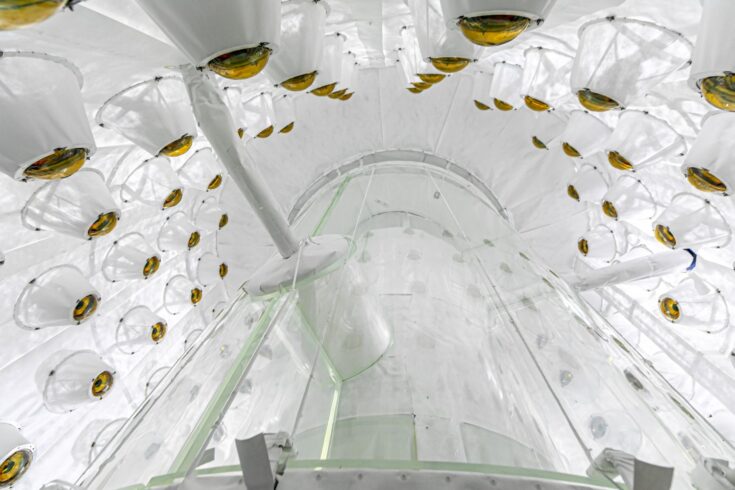
Looking up into the LZ outer detector, used to veto radioactivity that can mimic a dark matter signal. Credit: Matthew Kapust and Sanford Underground Research Laboratory
Dark matter is thought to make up around 85% of all the matter in the universe, yet it has never been directly detected.
A new analysis from the LZ experiment has identified a single particle interaction that researchers, led by the University of Bristol, have struggled to explain using any known background process.
The result falls short of the statistical threshold required to claim a discovery but is the most compelling hint of dark matter the experiment has reported to date.
LZ is an international collaboration of around 250 scientists and engineers.
The detector uses 10 tonnes of ultrapure liquid xenon to search for weakly interacting massive particles (WIMPs).
It is managed by the US Department of Energy’s Lawrence Berkeley National Laboratory and operates nearly a mile underground at the Sanford Underground Research Facility (SURF) in South Dakota, US.
The analysis behind today’s result was led by the LZ group at the University of Bristol.
It was presented at the 2026 TeV Particle Astrophysics conference in Japan, and the accompanying paper will be posted on arXiv and submitted to the journal Physical Review Letters.
Sam Eriksen, a senior research associate at the University of Bristol and lead author of the study yesterday said:
This was a detailed study in a region we hadn’t explored within this dataset, and we spent months of additional effort to understand all the possible causes of background events.
We understand our detector and the backgrounds so well that even a single outstanding event, like the one we found, is important. We expect dark matter events to be extremely rare, so only a handful could mark the first detection of WIMP dark matter.
If the event was caused by dark matter, it would point to a WIMP with a mass of at least 200 GeV/c² (gigaelectron volts).
That is more than 200 times the mass of a proton, interacting with ordinary matter in a way not covered by the simplest theoretical models.
The result stands at 2.6 sigma significance, meaning there is roughly a 0.5% chance it could be explained by known backgrounds alone.
This is well short of the 5-sigma threshold that physics requires before a result can be called a discovery.
LZ will continue collecting data at SURF, allowing researchers to test whether the signal grows stronger, weakens, or disappears as more data is gathered.
Rick Gaitskell, a professor at Brown University and the spokesperson for LZ, yesterday said:
We’re very intrigued to see this event in the data, in the region where we expect dark matter to show up and the competing backgrounds are very low.
With only one event, we don’t want to get ahead of ourselves. We are not claiming to have seen dark matter. But we have seen something interesting that we want to share with the scientific community for their input.
Major UK role
Funded in the UK by the Science and Technology Facilities Council (STFC) for both construction and operations, 10 UK teams play a central role in LZ:
- University of Bristol
- The University of Edinburgh
- Imperial College London
- King’s College London
- University of Liverpool
- University of Oxford
- Royal Holloway, University of London
- The University of Sheffield
- University College London
- STFC Rutherford Appleton Laboratory
LZ brings together around 250 researchers from 39 institutions worldwide with some 50 UK researchers contributing to operations, data analysis and collaboration leadership since the experiment’s commissioning in 2021.
STFC’s national laboratories, including the Particle Physics and Technology Departments, and the Boulby Underground Laboratory, have been central to designing, testing and delivering the experiment’s most vital elements.
The analysis behind today’s result was led by the LZ group at the University of Bristol, whose contribution was instrumental.
Professor Henrique Araújo, from Imperial College London and STFC’s Particle Physics Department, leads the LZ project in the UK.
He yesterday said:
Many in the UK team contributed to this analysis, but clearly the Bristol group had to endure the level of scrutiny one reserves to such a big result. I’m happy to report that, after a couple of years of analysis, they came out the other end. I’m already looking forward to examining more data. I also want to say that we’re only in this prime position because we helped design and build a fantastic instrument!
Professor Pawel Majewski, Dark Matter group leader at STFC’s Particle Physics department and LZ co-investigator, yesterday said:
Years of LZ’s exploitation and scientific achievements have demonstrated the maturity of liquid xenon technology and underscore the need to continue scientific exploration with a much larger experiment, enabling discoveries that, with today’s announcement, could be literally around the corner.
The next generation of dark matter detection
LZ’s results include the most significant observation of solar boron-8 neutrinos, and today’s result, which could be an early hint of a dark-matter detection.
Together, they reflect years of collaborative work across the international team and point to the value of continuing the search with a larger successor experiment.
The UK team is already working with international partners on XENON-LUX-ZEPLIN-DARWIN), a next-generation rare-event observatory for dark matter detection and neutrino physics.
The project is currently supported by a UKRI Infrastructure Fund preliminary activity, and the UK is exploring the possibility of hosting the experiment at the Boulby Underground Laboratory.