RUSI
 Printable version Printable version
|
‘Eating Their Young’: The Fratricidal Throes of a Sudanese Kleptocracy
As Sudan’s generals feed the meatgrinder, jeopardising their country’s future and displacing thousands of civilians, questions need to be asked over why the warning signs were missed.
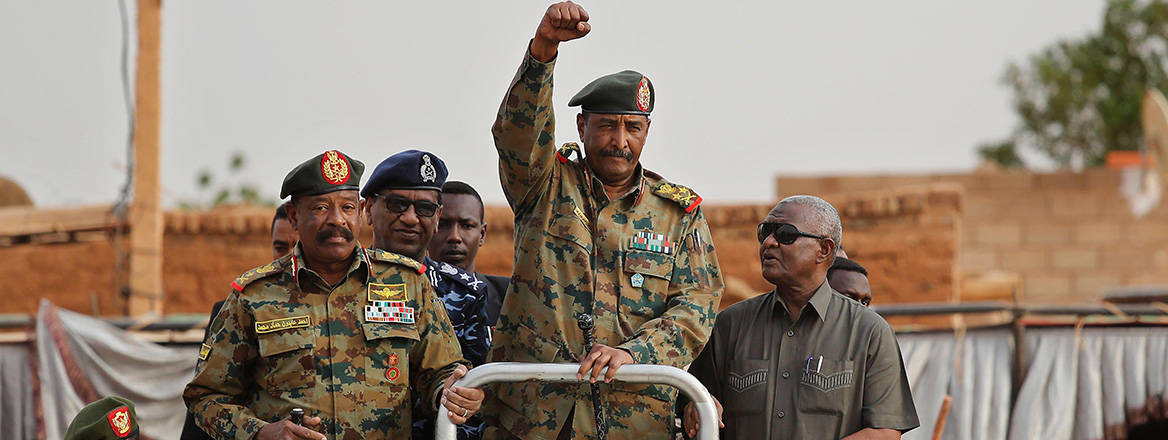
In recent months, tensions between General Abdel Fattah Al-Burhan’s Sudanese Armed Forces (SAF) and the Rapid Support Forces (RSF) – a militia-turned-paramilitary group led by Mohamed Hamdan ‘Hemmeti’ Dagalo – finally spilled over into open warfare. Greater in scale and intensity than many predicted, analogies have already been drawn to the ‘chaotic free-for-all’ in Libya or the systemic collapse of Somalia. At once a regional crisis and humanitarian tragedy, the violence reflects – as Alex de Waal argues – a ‘revolution no one wanted’: the convulsions of a rapacious, kleptocratic logic coming full circle. At the same time, it exposes chronic failures among international donors, from poor assumptions to inadequate capacity and a lack of strategic vision. As efforts continue to find a ceasefire that sticks, it is therefore essential to understand the genesis of the conflict and why the diplomatic community got it so wrong.
Collective Failures
The immediate trigger stems from negotiations over a civilian transition after more than two years of coup governance. Having subscribed to the UN-backed Framework Agreement in December 2022, the RSF, military and Forces of Freedom and Change Central Council (FFC-CC) – an umbrella for around 40 civil society groups – launched ‘Phase II’ a month later, focusing on regime accountability and security sector reform (SSR). From the outset, analysts raised concerns over a truncated process primarily designed for foreign consumption. Keen to stave off complete economic collapse, donors, international organisations and Sudanese politicians pushed a suite of proposals lacking popular buy-in or support from neighbourhood resistance-committees. Crucially, they also neglected internal politics within SAF itself, opting to recognise the RSF as a ‘regular entity affiliated with the armed forces but under the direct command of a civilian head of state, rather than the army chief’. Benefitting Hemmeti – who could conceivably retain an independent powerbase – the arrangement was criticised by Sudan’s top brass as a vehicle for extending paramilitary influence, likely at the expense of the country’s regular forces.
The final straw may have involved pathways and timeframes for integration – Hemmeti demanded 10 years to Al-Burhan’s two, and the dismissal of 800 SAF officers – but both parties were already conducting large-scale recruitment drives across Darfur. Reports of army officials dispensing cash to Rizeigat and Al-Ta’aisha – core RSF constituencies – were accompanied by leaks from Military Intelligence accusing the group of importing armed drones via Turkey. Rumours spread of provincial bosses and Border Guard militia receiving salaries, promotions and the promise of plum jobs abroad. Hemmeti in turn cast Al-Burhan as a ‘radical Islamist’, re-emphasising claims that the October coup was a ‘mistake’ and ‘gateway for the return of the former regime [fronted by the National Congress Party, NCP]’. With Al-Burhan already ‘backtracking on previous statements’ over the terms of transition, these narratives chimed with many in the FFC-CC who saw SAF as a redoubt for NCP loyalism. In response, military spokesmen and media outlets maintained they could not ‘make an agreement…[with] two armies in the country’. As tensions ratcheted up, talks broke down: neither outfit attended the final workshop on SSR and – beneath a professed commitment to peaceful mediation – both reinforced their positions across the capital.
Who fired first is unclear but on 13 April, RSF troops surrounded an airbase housing Egyptian MiG-29M/M2 Fulcrum fighter-jets in the northern town of Merowe. Two days later, clashes broke out across major cities, with ‘tanks driving through the streets of central Khartoum’ and heavy gunfire reported outside the state broadcaster, Republican Palace, Ministry of Defence, and international airport. Susceptible to aerial strafing and rocket fire, militiamen occupied hospitals and residential neighbourhoods, converting apartments into make-shift strongholds and taking the families of army personnel hostage. In response, Special Forces raided large RSF camp-complexes in Soba and Tiba as infantry and Central Reserve Police (CRP) attempted to reclaim bridges, highways and strategic districts such as Al-Bagair industrial zone. Even when combined with air-support, these efforts nonetheless found little traction. By early June, the RSF held much of Bahri, downtown Khartoum, and pockets of Omdurman. Having overrun multiple SAF bases, including the sprawling Yarmouk weapons factory, the group was able to encircle further hold-outs – the Shajara Armoured Corps and Corps of Engineers – until they were eventually forced back by a short-lived counteroffensive. Although the frontlines remain fluid, the army is now ‘heavily outnumbered’ across the capital, with Sudan War Monitor reporting the loss of CRP’s local headquarters alongside ‘dozens of Shareef-2 armoured vehicles, huge amounts of ammunition, and more than 100 pickup trucks’.
Further afield, fighting may be primarily concentrated in Darfur, but incidents continue across White Nile, Blue Nile, and North Kordofan, together with rising tensions in Gedaref and eastern border-towns. Over 3,000 civilians have been killed, with others running low on basic necessities while stuck in ‘40-degree Celsius heat without electricity or […] water’. Many describe shortages of food and medical supplies as looters and shelling push neglected infrastructure to the point of collapse: at least a third of Sudan’s health facilities are no longer functioning. Resistance committees appear to be ‘repurpos[ing] themselves as emergency networks for community information [and] protection’, but as the only source of ‘civic governance’ available they are over-stretched, under-resourced and dangerously exposed. Humanitarian offices have likewise been plundered and markets burned, cutting off displaced populations in Darfur as up to 90,000 people – mostly women and children – flee across the border. UN Refugee Agency officials anticipate a further 270,000 refugees may try to reach Chad and South Sudan. In the north, more than 110,000 have already arrived in Egypt.
Successive ceasefires have yielded little, with a 72-hour truce negotiated by the US and Saudi Arabia on 24 April only offering a brief window to evacuate foreign nationals and doing little to alleviate the suffering of Sudanese themselves. Over nine subsequent deals have since folded, including a 10-day agreement brokered at Jeddah which suffered repeated violations and collapsed in the lead up to a new SAF offensive in June.
At the same time, Western diplomats recall being ‘blind-sided’ by the violence, admissions congruent with helicopters taking off from the US embassy and confused instructions relayed by the UK’s Foreign, Commonwealth and Development Office. Ten days prior to the conflict, officials were allegedly expressing ‘cautious optimism’ about the transition process. Even Volker Perthes, UN special representative to Sudan, claimed ‘we did not have any early warning’, despite attending iftar at the home of Lieutenant-General Shams Al-Kabashi, the army’s deputy commander, hours before gunfire broke out.
The violence exposes chronic failures among international donors, from poor assumptions to inadequate capacity and a lack of strategic vision
Crucially, however, such narratives overlook well-known realities of the country’s history and political economy: conditions reproducing and institutionalising violence, and fixing the likes of Hemmeti and Al-Burhan – two kingpins of ‘kleptocratic cartels’ – in a long-running rivalry. The signs were there.
New Faces, Old Problems
Many of these dynamics trace back to the colonial anatomy of the Sudanese state. As Joshua Craze summarises: ‘postcolonial strife followed the lineaments of colonial rule, with a riparian elite in Khartoum and its satellite cities, dominated by a few families, fighting against the multi-ethnic peripheries of the country, which they exploited for labour and resources’. The same recipe has been recycled by every government since independence, turning ‘rural surpluses into foreign exchange that pays for the basic food and energy needs of urban consumers’ across Sudan’s metropolitan core, the so-called Hamdi Triangle. Reliant on local strongmen to maintain control, these processes militarised countryside production and ‘pastoral livelihoods’, reducing outlying regions like Darfur to ‘conflict gig econom[ies], with armed units up for hire on a case-by-case basis’. Although pre-dating his regime, former President Omar Al-Bashir expanded this model to cover the import of wheat, petroleum and luxury goods, outsourcing state functions and deputising militias as a ‘key technique for rural governance and resource extraction’. Dubbed ‘counter-insurgency on the cheap’, his policies licensed a raft of surrogates including the Janjaweed – a mix of Abbala herdsmen, Chadian exiles, and the sundry remnants of Muammar Qadhafi’s Islamic Legion – to attack civilians and rebels alike, sequencing cluster bombings by the Sudanese Air Force with mass killings and ethnic cleansing.
Unsurprisingly, the approach proved destabilising over time. Militia recruitment grew tenfold between 2003 and 2013, saturating the market with new start-ups. As land, loot and largesse ran dry, local commanders increasingly turned on both the government and one another, a problem exacerbated by the discovery of gold seams in Darfur. Musa Hilal, head of the Border Intelligence Brigade, for instance, was able to carve out a personal fiefdom across Jebel Amer, converting a 400-strong network of mines into a ‘gigantic ATM’ worth around $54 million per year. Low on cash after losing South Sudan’s oilfields and needing to regain some grip over the rural economy, Bashir overruled his army chief of staff in 2013, regularising Fut-8 Battalion – a Mahariya outfit led by Hilal’s rival Hemmeti – as a ‘super-paramilitary’ under the authority of the National Intelligence and Security Service (NISS), and later himself. Repackaged and expanded as the ‘Rapid Support Forces’, the group seized checkpoints and contraband routes across the interior, enforcing a series of disarmament campaigns to arrest Hilal and capture much of the country’s gold trade. At the same time, the 2017 budget insulated RSF funding from SAF, preserving a discrete chain of command and positioning Hemmeti as a counterweight to the military.
Short of liquidity, Bashir’s ‘transactional machine’ became steadily dependent on this security-centric oligopoly, with the RSF and army exploiting new sources of (post-oil) political finance: minerals, crops, land and mercenaries. While outwardly ‘collusive’, competition between the two – baked into the system from the start – became increasingly tense. Much of SAF’s rank and file
Original article link: https://rusi.org/explore-our-research/publications/commentary/eating-their-young-fratricidal-throes-sudanese-kleptocracy