National Archives
 Printable version Printable version
|
Exploring archival value: Does the ‘perfect parchment’ exist?
The latest in our series of events encouraging new ways to engage with our collections explored the feel, texture, and appearance of parchment.
The National Archives’ new annual event series, Research Routes, encourages you to engage with our collections in new and innovative ways. Through a series of online talks and in-person workshops, our 2025/2026 programme, ‘Emotions, senses and feelings in the archives,’ explored how we navigate the archives and how our senses relate to our emotional reactions, learning, and perception of history.
As part of the series, on Tuesday 10 February, The National Archives’ Collection Care Department hosted a hands-on workshop titled, Does the ‘perfect parchment’ exist? Sensing the value of tangible heritage, in collaboration with Madison Bennett, a PhD researcher from the University of Cambridge. This sold-out event brought together creative practitioners, conservators and historians with interested members of the public. Together, we questioned how material qualities influence how we perceive value in the objects we preserve.
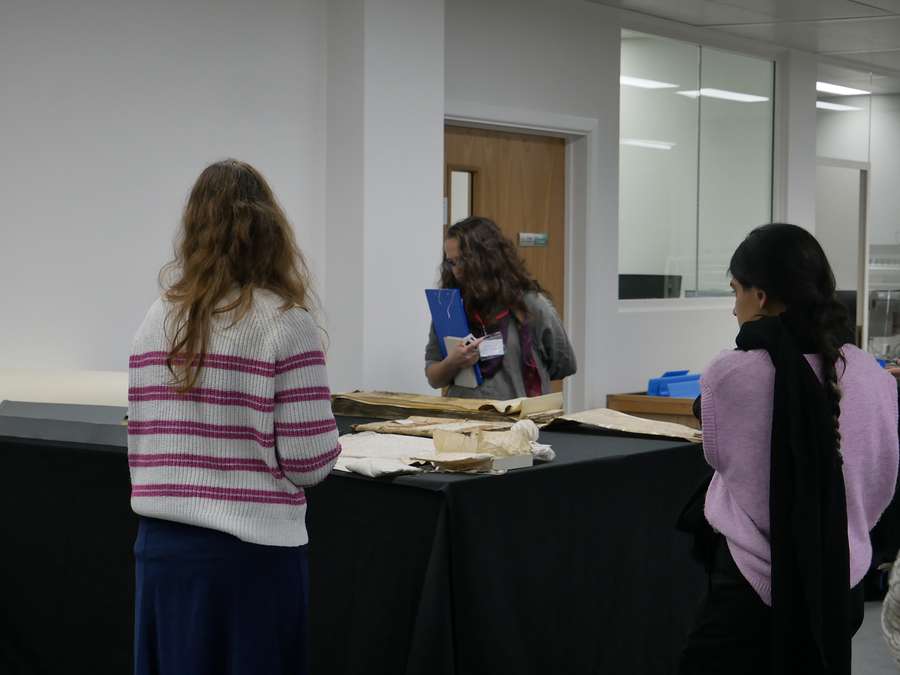
Participants engage with a document display in the Collection Care studio. Photograph taken by Mollie Clarke.
The day began with the participants viewing a diverse display of documents made of parchment, from medieval manuscripts to modern artwork. They were asked to assess and assign value to the objects, ranking them from high to low without context or a prescribed definition of what ‘value’ could be. The participants also discussed how they would define parchment and vellum (calfskin), how many hours they thought went into creating it, and how they would rate parchment as a material, drawing on emotional, sensory, and tangible engagement with the objects.
A dying art
Authentic parchment is made from animal skin through a traditional process of liming, stretching, and scraping. The highly specialised, labour-intensive craft of parchment making has declined significantly with the rise of paper. Though rare, skilled parchment makers continue the tradition.
Madison investigates lost techniques of medieval manuscripts and parchment production. In the Collection Care studio at The National Archives, she taught the participants what parchment is and how it is made, exploring different species, uses, and qualities of parchment. Through a range of activities, including microscope analysis, a parchment-making demonstration, and the opportunity to touch the material in its different forms, participants gained a unique perspective on the historical and cultural significance of parchment.
Historically, different animal skins were selected for parchment based on their specific qualities, such as thickness, grain, and softness, to suit various purposes. The most common animals used were calves, sheep, and goats.

Participants analyse parchment samples under microscopes in the Collection Care studio. Photograph taken by Mollie Clarke.
Because of its durability, resistance to tampering, and longevity, goatskin was used for legal documents for hundreds of years, particularly in Britain. Until 2016 the House of Lords were printing of laws on parchment. Record copies of Public Acts, passed since the beginning of the 2015 Parliament, are now printed on archival paper, with front and back vellum covers. This compromised approach accommodates the need to preserve traditional crafts and utilise modern methods of record-keeping.
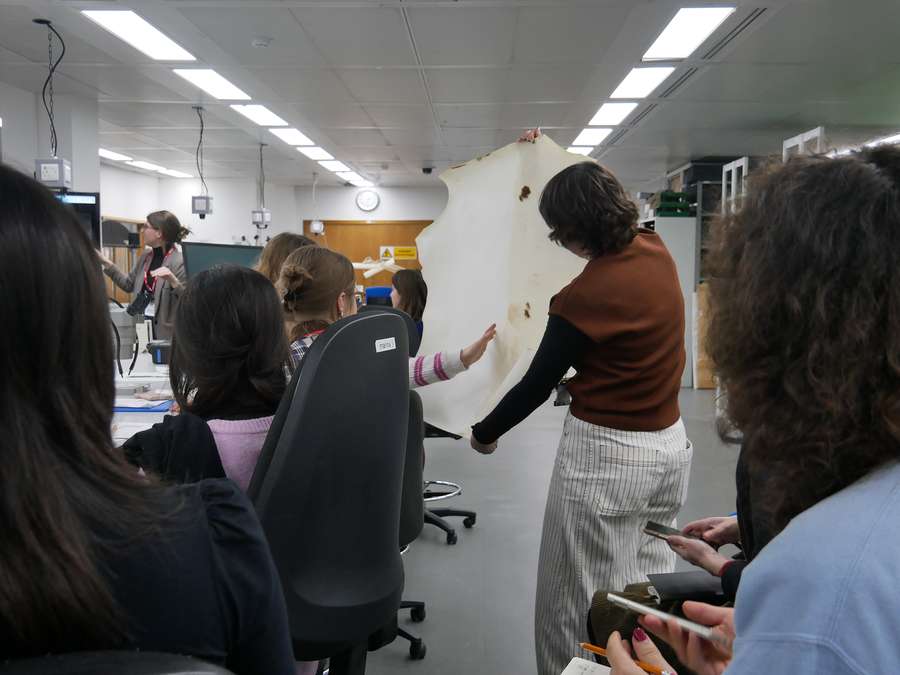
Madison Bennett presents to participants on the history of parchment. Photograph taken by Mollie Clarke.
Perceiving value: Emotion, experience, and interpretation
Value is a subjective concept. In the context of this workshop, an object’s worth was determined by individual perceptions, based on feelings, not fact. There are occasions where museums and archives must assign a monetary value to the objects they acquire, according to prevailing market conditions, documentation, provenance, and physical inspection. However, instead of estimating monetary value, the participants were encouraged to think holistically about the documents in the display. Being part of an archival collection, their value lies in their cultural, historical and research significance.
Individual perceptions are based on a combination of sensory information (what we see, hear, smell, taste, and touch), past experiences, personal beliefs, values, and emotions. The participants’ individual passions and interests influenced their decision-making, shaping how they felt the objects should be evaluated both in terms of their history and materiality, which refers to the physical, tangible properties of documents.
One participant with a book conservation background highly valued an account book from the 1300s (catalogue reference: E 101/180/2) because of its original binding. Another assigned value to original use, putting a letters patent of Edward III (catalogue reference: E 30/1105) at the top of their ranking because of the importance attached to the law and Crown. Both consider the information we gain from the objects, but in different ways. Insights into the history of the documents can be found within their pages, not only by analysing the words on them, but also the ink with which the words are written, for example.
Common themes also included rarity and age. The older and more unique an object looked, the more valuable it was perceived to be.
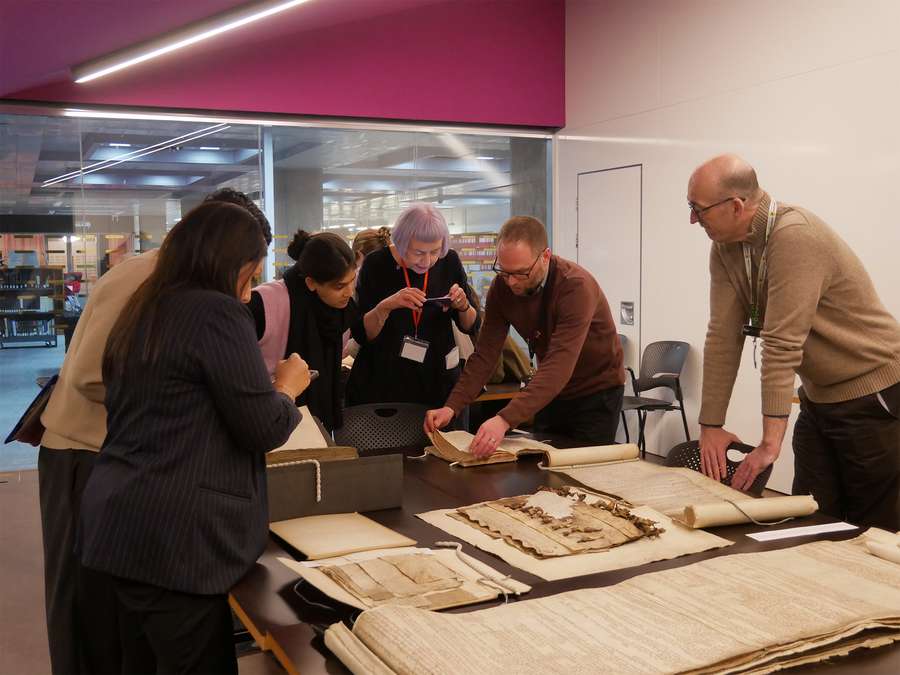
Records Specialists and participants discuss the historical context of archival records during a ‘round robin’ exercise. Photograph taken by Mollie Clarke.
Authenticity, reliability, integrity, and usability
According to international standards (ISO 15489: 2016) – which outlines core concepts and principles for the creation, capture and management of records – authoritative records possess four key characteristics:
- Authenticity
- Reliability
- Integrity
- Usability
Authenticity can be verified by analysing the content and structure of a record. Similarly, integrity ensures that a record is complete and unaltered. Although complimentary, these characteristics sometimes conflict.
Parchment is highly sensitive to moisture, often returning to its original animal shape if wetted. It requires stable environmental conditions to avoid brittleness or mould, among other things. Take the King’s Bench record (catalogue reference: KB 145/3/5/1): its structure and materials hold important information about its history, but it is also a legal document and archival record used for modern-day research purposes. Should its original form be altered to make it more usable and, if so, will the authenticity and integrity of the record be affected?
Some will consider its value lost with its original form, whilst others will see an increase in value with an increase in usability and accessibility. The primary purpose of archives is to ensure the permanent preservation of records while making them accessible to the public. Therefore, archive conservators work at the interface between preserving the physical record and accommodating the needs of the future user. They are highly skilled professionals who possess a deep understanding of and respect for the original materials and the custodial and intellectual integrity of the objects in their care. A careful balance must be struck between preserving the information found in a record’s text and ensuring collections are open and accessible.
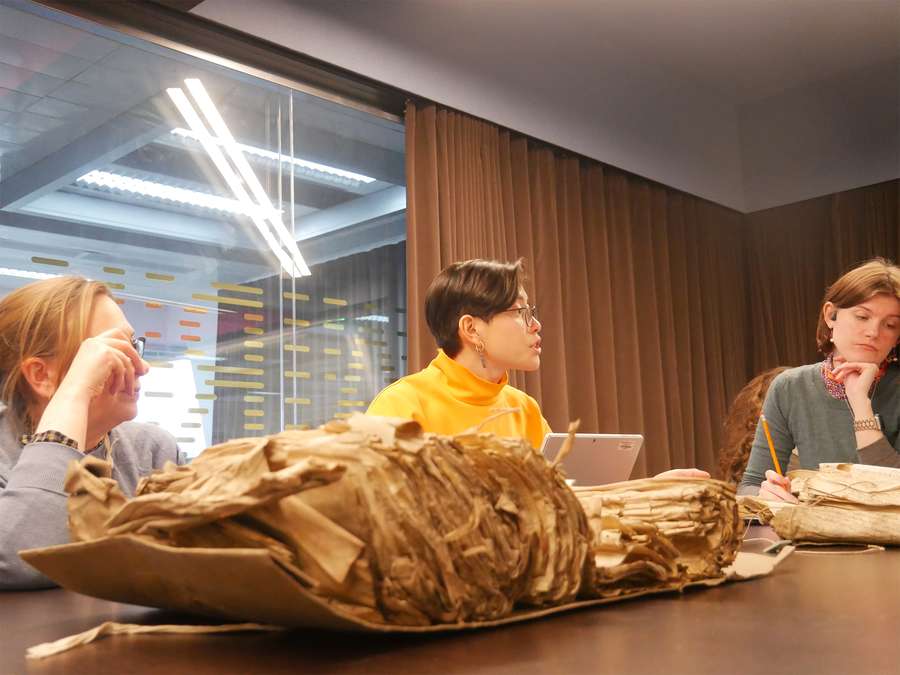
Participants examining and discussing parchment. Photograph taken by Mollie Clarke.
Context is everything
In the afternoon session of the workshop, the participants and archive conservators were joined by records specialists from the Collections Expertise and Engagement Department at The National Archives. During a round robin brainstorming exercise, participants continued to explore the materiality of archives, the historical context of the documents on display, the value of parchment to scientific study, and the different ways we assess their value. By engaging in meaningful conversations like these, the workshop brought together people with diverse backgrounds and perspectives who enriched one another through the exchange of knowledge and ideas.
At the end of the workshop, participants were asked to reassess the value of the objects – this time with the added context they had gained throughout the day. Many agreed that learning more about the craftsmanship and historical context of documents changed the way they ranked them. Yet, the exercise remained highly personal. Personal bias, both conscious and unconscious, affects decision making. Certain histories resonated more than others because they act as emotional and identity-shaping narratives, or simply, they align more with one’s research interests.
This subjectivity did not diminish participants’ enhanced understanding of materiality or its role in shaping the histories that archives represent. As one participant observed, the documents have ‘value in different areas’, while another explained their ranking decisions were ‘based on historical and material value’.
Archival records are material traces of past events and actions, providing physical evidence and proof. The feel, texture, and appearance of parchment can be just as valuable as the historical information it carries. This invites wider reflection on how we access and interpret archives in an increasingly digital world, where physical engagement with materials is often limited.

Madison Bennett demonstrated how to stretch animal skin in the process of parchment making. Photograph taken by Mollie Clarke.
So, does the ‘perfect parchment’ exist?
No. Context is everything, especially the context of use. As a result of the workshop, the participants shared a deeper understanding of parchment and appreciation for its craft. They agreed that its value is largely dependent on its desired use and usability.
Importantly, archival records are not static, their function changes with time. Whilst the smooth, sometimes velvety texture of vellum allows for intricate detailing and fine lines, it may not have the same longevity as goatskin, for example. Vellum is ‘perfect’ for painting and illustration in the moment but may become too brittle and fragile to access in the future.
As one participant said, ‘perfection does not exist.’
Original article link: https://www.nationalarchives.gov.uk/professional-guidance-and-services/our-research-and-academic-collaboration/our-research-projects/research-projects/exploring-archival-value-does-the-perfect-parchment-exist/