National Institute for Health and Clinical Excellence (NICE)
 Printable version Printable version
|
Faster, fairer access to HealthTech under new national programme
People across England and Wales are set to receive faster, fairer access to innovative HealthTech under the new National HealthTech Access Programme (NHAP).
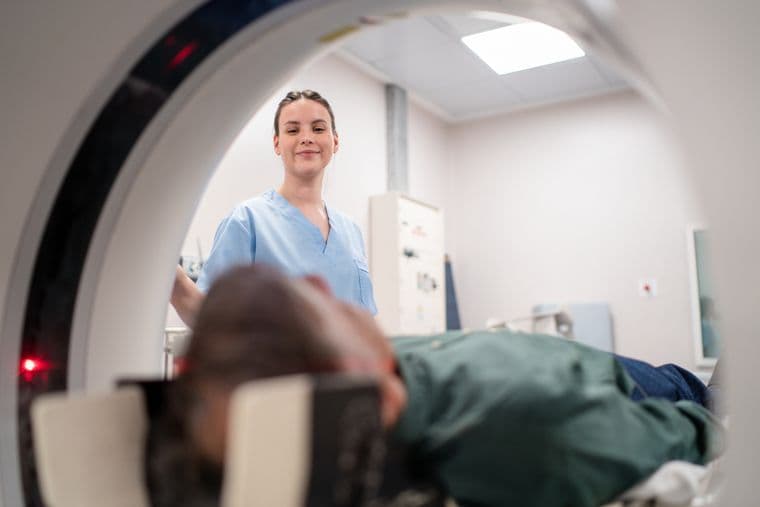
The 10 Year Health Plan set out how the government will address the long-standing challenge that cutting-edge HealthTech is not being used in the NHS , or is only available to patients in some parts of the country.
The new National Healthtech Access Programme (previously called the Rules Based Pathway) is a collaborative approach between NICE, the Department of Health and Social Care, NHS England, MHRA and the Office for Life Sciences. The approach will expand NICE’s Technology Appraisals programme to incorporate health technologies. This means that like medicines, a small selection of high-impact technologies will be reimbursed and made available across the entire health service.
NICE has announced that the first two topics to go through the new programme are capsule sponge tests for detecting oesophageal cancer and AI tools for identifying prostate and breast cancer – technologies that could transform early diagnosis for thousands of patients each year, and drive workforce efficiency in the NHS through releasing capacity.
The new programme forms part of a strategic open innovation approach to HealthTech that is set out in the 10 Year Health Plan to create a far better experience for patients and NHS professionals, unlocking the extraordinary potential of HealthTech advances and the UK’s HealthTech sector.
Professor Jonathan Benger , Chief Executive of NICE, yesterday said:
When NICE was founded 26 years ago, it set out to end the postcode lottery in access to medicines. We’re now extending that same clarity and fairness to HealthTech. These reforms mean that clinically and cost-effective medical devices, diagnostics and digital tools will start to be reimbursed and made available consistently across the NHS. This will give patients faster access to proven technologies and ensure NHS resources are spent where they make the greatest difference.
‘Pill on a string’ for early detection of Barrett’s oesophagus and oesophageal cancer
Oesophageal cancer is often diagnosed too late, leading to poor outcomes and significant pressure on NHS diagnostic services.
Early detection is transformative: patients with early-stage disease have a 95% five-year survival rate, compared with 5-40% when diagnosed at an advanced stage.
Capsule sponge tests, sometimes called ‘pill on a string’, are small capsule-shaped devices that are used for detecting abnormal cells associated with Barrett’s and early cancer. Patients swallow the capsule, while supervised by a healthcare professional, but without the need for sedation.
The capsule is dissolvable. When swallowed, it expands into a small, rough-textured sponge in the person's stomach. The device is then extracted via a string attached to the sponge. After it is taken out, the cells collected from the oesophagus are tested for cells that could become cancerous.
The technology provides a far less invasive alternative to endoscopy, for the early detection of oesophageal cancer and the surveillance of Barrett’s oesophagus, where cells can grow abnormally and can occasionally become cancerous. As well as supporting faster pathways to diagnosis, it also helps free resources for urgent oesophageal cancer investigations.
Harnessing the power of AI to help detect breast and prostate cancer
AI tools for interpreting images of tissue samples have the potential to transform diagnostic pathways for suspected prostate and breast cancer—two of the NHS’s largest caseload areas.
The AI tools are algorithms that analyse these images, highlight suspicious regions and grade tumours.
This supports pathologists by reducing routine workload, improving consistency, and enabling faster prioritisation of high-risk cases.
Benefits to the wider health and care system include:
- Increasing accuracy, standardisation, and reporting speed—directly supporting the NHS’s Faster Diagnosis framework and its ambitions for AI adoption in cancer pathways in its Long Term Plan.
- Reducing workforce pressures by automating routine tasks and freeing pathologist time for complex cases.
- Supporting national cancer targets, reducing diagnostic bottlenecks and improving throughput.
- Potentially reducing inequalities in time to diagnosis linked to geography, deprivation and variation in access to specialist pathology expertise.
Ministers have also referred two other topics to NICE subject to further evidence. They are technologies to improve detection of endometrial cancer in women with unexplained vaginal bleeding, and the use of AI-to help analyse chest X-rays for suspected lung cancer in primary care referrals.
The NHAP is one of 3 commitments that NICE will deliver as part of the government’s 10 Year Plan for the NHS. These are:
- Faster, fairer roll out of high impact healthtech.
- Updating guidance to drive smarter spending.
- Parallel decisions for faster access.
Find out more about how NICE will deliver these priorities to help deliver faster, and fairer access to the best innovations.
This week NICE is launching a national campaign to raise awareness of this programme and how our guidance can support NHS decision making, and market entry for developers.
For those developing or adopting healthtech, learn more on our healthtech pages.
Original article link: https://www.nice.org.uk/news/articles/faster-fairer-access-to-healthtech-under-new-national-programme