RUSI
 Printable version Printable version
|
Gulf War III is a Warning About the Effects of a ‘Taiwan Straits War I’
Ripples of economic disruption radiating from the attack on Iran by Israel and the US give notice of the effect a war over Taiwan would spread through the world.
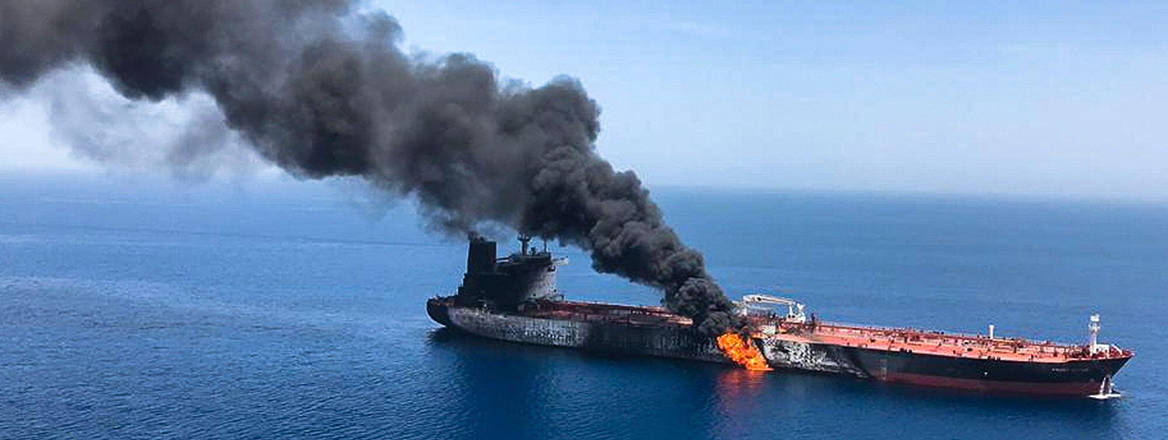
The economic shock from what Niall Fergusson calls ‘Gulf War III’ is largely being transmitted through the medium of the global shipping industry. The proportion of the world’s fossil fuel sourced from the Persian Gulf is only part of the reason this war risks triggering a global recession. A less examined reason is the critical importance of major Asian economies (China, Japan, South Korea, Taiwan) to global commerce, combined with their vulnerability to the breakdown in the international shipping network that carries their fuel but also the parts and products to assembly and markets. It is important to understand this fragility and consider ways to mitigate it in order to prepare for a similar crisis that could spread out from a possible conflict over Taiwan.
The economies of China, Japan, South Korea and Taiwan account for over a quarter of nominal global GDP, and much more than that if measured in terms of purchasing power parity. All of them rely on maritime trade for a large portion of their energy supply and the transportation of industrial inputs and products. Their economies are linked to each other and those of nations across the region and the world by a dense and complicated supply chain network. If something happens to cause that network to break down or shipping to stop, the effect on the global economy would be comparable to what is taking place as a consequence of Gulf War III.
An attempt by China to take control of Taiwan by force would impose a zone of danger across the world’s most important shipping lanes. Uncertainty about the probability of other countries like America and Japan entering the conflict would prompt insurers to consider the worst-case scenario, where the area listed for war-risk extends some distance into the Pacific, south towards Australia and potentially into the Indian Ocean. If insurance was on offer, it would be expensively priced. In the short term, when uncertainty is at its height, there is no guarantee that insurance would be available at all.
Pretending that a Taiwan crisis would be anyone’s ‘internal matter’ is as absurd and irresponsible as claiming the current Gulf conflict is of concern to the direct belligerents alone
Until recently, war games simulating such a crisis tended to assume that this problem could be addressed by providing navy escorts to enable commercial ships to sail on through a crisis. However, President Trump’s offer on 3 March 2026 to provide escort and insurance has yet to make much impact on the willingness of the shipping community to carry on sailing.
Shipping is a global industry that functions efficiently and reliably within a multi-stakeholder ecosystem consisting of owners, crews, representative bodies, banks (most ships are mortgaged), flag state jurisdictions, insurers, re-insurers, underwriters, ports and sundry service providers (including maritime private security companies). The incentives that inform its decision-making are balanced across jurisdictions and relationships with a range of customers that is mostly blind to political or ideological considerations, such that it is not beholden to any single higher authority. This means that although shipping is not ‘sovereign’ in a formal sense, in terms of its behaviour, it has some of the attributes of a sovereign entity.
Click here for the full press release
Original article link: https://www.rusi.org/explore-our-research/publications/commentary/gulf-war-iii-warning-about-effects-taiwan-straits-war-i