Breakthrough
 Printable version Printable version
|
How are you really using AI? Try this 15-minute self-assessment to find out!
An easy, practical way to evaluate AI habits and reflect on AI thinking
AI has become a part of our everyday life. Be it at work, at home, or even when we learn. It helps draft emails, summarise meetings, unblock writer’s block, and answer questions faster than ever. For many people, opening an AI tool now feels as normal as opening a browser.
This new normal, while useful, also hides something very important. Today, most people use AI, yet very few pause to reflect on how or why they are using it. The result is not bad behaviour or wrong behaviour. It is simply unconscious behaviour.
This AI usage self-assessment is not a test. It is not about using AI correctly or incorrectly. It is about taking a pause, reflecting, and noticing patterns that may have formed quietly in the background. Think of it as exploring the difference between AI thinking vs AI doing.
What is an AI usage self-assessment? It is a simple way to step back and understand how AI currently fits into your decision-making and learning. This is about awareness, not optimisation. Better AI outcomes usually start with clearer human judgment.

Why should you audit how you are using AI?
Let’s answer the first question on everyone’s mind: Why should I audit how I use AI? The short answer is habit.
We all know that AI tools are fast, helpful, and always available, which is probably why they have been adopted so quickly. Without noticing, people can slip into patterns where AI is used automatically rather than intentionally.
This can look like asking AI for reassurance instead of a challenge. It can look like skipping personal thinking and going straight to an answer. It can also look like using AI frequently but shallowly.
Frequent use is not the same as thoughtful use. Someone can open AI ten times a day and still not be using it in a way that meaningfully supports decision-making or learning.
To audit your AI usage is to pause long enough to evaluate AI habits that may have formed on autopilot.
A 15-minute AI usage audit
We have a practical AI audit technique that focuses on behaviour and not feelings. When you use this, you will not be estimating how you think you use AI, but rather counting how you actually use it
This works as a self-reflective AI check that anyone can do. It doesn’t need to be downloaded; it requires no templates or tools. You can do it whenever you want to.
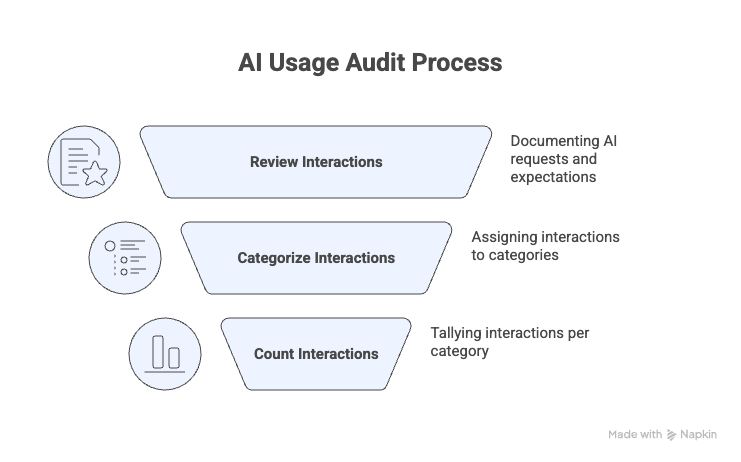
Step 1: Review (5 minutes)
Look at your last 10 AI interactions. If you use AI less frequently, look at your last 5. These can be from work, learning, or personal use.
For each interaction, write down:
- What you asked AI to do
- What you were hoping it would give you
Keep this factual. You are documenting behaviour, not performance.
Step 2: Categorise and count (5 minutes)
Now assign one point to each interaction by placing it into the category that fits best.
- Execution and speed
You wanted AI to complete, summarise, rewrite, or finish something quickly. - Validation and reassurance
You wanted confirmation that your idea, decision, or approach was correct. - Thinking support
You wanted help clarifying, structuring, or organising your own thinking. - Exploration and learning
You wanted to open up new perspectives, alternatives, or questions.
This will help you objectively evaluate AI habits rather than relying on memory or mood.
Step 3: Calculate your score (5 minutes)
Now, add how many interactions sit in each category. The category with the highest number is what shapes your AI behaviour the most.
So the next time you hear about an AI usage audit, don’t just ask yourself; how do I perform an AI usage audit? We have got the exact way you can do this, simply come here and start!
What is your AI usage score?
Your AI usage score is not a grade. It is a snapshot of how you currently rely on AI, based on observed behaviour.
Whichever category received the highest number of points in the audit is your score.
Execution-led User
If you scored the highest in execution and speed, it means you use AI primarily to help you move faster and complete tasks.
It supports efficiency and momentum. It may limit depth if speed becomes the default.
Validation-led user
If you scored the highest in validation and reassurance, it means you often use AI to confirm decisions or thinking.
It supports confidence and certainty but may limit gathering alternative perspectives.
Thinking-Support user
If you scored highest in thinking support, it means you use AI as a decision-making support to clarify and strengthen your reasoning.
It supports judgment and structure. It may limit exploration if rarely pushed further.
Exploration-led user
If you scored highest in exploration and learning, it means you use AI to expand your understanding and explore new possibilities
It supports curiosity and insight. It may feel slower, but it often leads to better outcomes.
Your AI usage score does not define if you are using AI correctly or incorrectly; it is simply a reflection of how you use an AI platform.
Interpretation of AI usage scores
The moment we associate scores with anything, the first thought on everyone’s mind is what should I do to improve this score. We are sure you are thinking, how can I improve my AI usage based on my score? We suggest focusing on small shifts, not an overhaul.
If you are execution-led, write one sentence of your own before prompting AI.
If you are validation-led, ask AI to challenge your view instead of confirming it.
If you are thinking-support-led, add one exploratory question.
If you are exploration-led, notice which prompts produce clarity and reuse them.
This is how you can be more mindful about your AI usage without adding complexity. Better AI productivity habits come from clearer intent, not more tools.

Build a more intentional relationship with AI
AI fluency is a human skill first. Tools will change, but judgment and awareness last.
This AI usage self-assessment is a reminder that you are still shaping the relationship between AI and you. When you audit your AI usage, you ensure AI supports your thinking rather than quietly replacing it.
At Breakthrough AI, learning is built for people who want to learn with AI, not keep up with it. Join the waitlist to continue building judgment, confidence, and clarity with AI.
How are you really using AI? Try this 15-minute self-assessment to find out! was originally published in Breakthrough Social Enterprise on Medium, where people are continuing the conversation by highlighting and responding to this story.
Original article link: https://wearebreakthrough.co.uk/how-are-you-really-using-ai-try-this-15-minute-self-assessment-to-find-out/