Think Tanks
 Printable version Printable version
|
IFS - Today’s public finance data show borrowing falling faster than expected
ONS figures show borrowing in the first 10 months of the year is £15 billion below the same months last year.
Nick Ridpath, Research Economist at the IFS, said:
“The data on the public finances is particularly important, given the outsized impact of January’s self-assessment returns on revenues and borrowing for the year as a whole. Income tax receipts had been a little disappointing over 2025, lagging behind forecasts even as inflation and wage growth exceeded expectations. But this data shows that self-assessment revenues in January were almost £2 billion (6%) higher than forecast. The government’s plan to run a current budget surplus from 2028-29 onwards is reliant on marked reductions in borrowing over the next few years – reductions that will be far easier to achieve if tax revenues continue to come in strongly.”
The Office for National Statistics published new figures on government revenues, spending and borrowing.
- The government normally runs a surplus in January. In other words, it raises more than it spends. These figures show that the surplus in January was £30 billion. This is more than double the figure for the same month last year, and a £6 billion improvement on OBR’s forecast from November. Much of the gap stems from significantly lower debt interest spending in January: the government spent £2.3 billion servicing its debt last month, around £4 billion below what was forecast by the OBR.
- Government borrowing is expected to be lower this year than last, as the government takes further steps towards its target for current budget surplus by 2029-30. Cumulative borrowing over the first ten months of this year is £15 billion lower than last year, meaning that borrowing is coming down even faster than expected
- Public finance data from January is particularly important, as it is when a large share of self-assessment income tax is paid. Income tax receipts have been disappointing up to this point in the financial year, lagging behind forecasts despite inflation and wage growth surpassing expectations. The data shows that for the second straight month, income tax receipts have surpassed the forecast produced only back in November. This may be a welcome sign that government receipts are starting to get the boost from inflation and wage growth earlier in the year.
These figures will be revised and revised again, and so we should not place too much weight on figures from any single month. All the same, out-turn data does provide important insights into the state of the economy and public finances, and points to issues that could affect the Office for Budget Responsibility’s forecast in a couple of weeks' time.
Figure 1. Cumulative monthly public sector net borrowing, outturns and OBR forecast
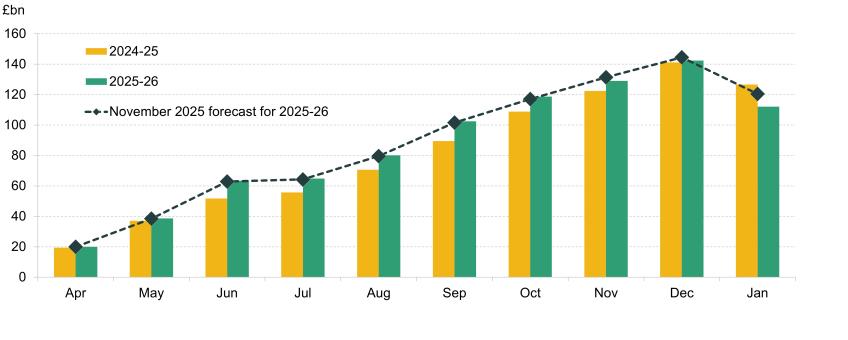
Source: Office for National Statistics Public Finance Statistics; OBR Economic and Fiscal Outlook, November 2025