Office of Rail and Road
 Printable version Printable version
|
Increasing fares revenue contributes to reduction in government subsidy for the railways
Train fare revenue for Great Britain’s rail network rose 8% to £11.5 billion between April 2024 and March 2025 when compared to the previous year, the latest statistics from the Office of Rail and Road (ORR) show. However, despite the number of passenger journeys approaching pre-pandemic levels at 1.7 billion, fare revenue continues to lag behind at 12% behind pre-pandemic levels.
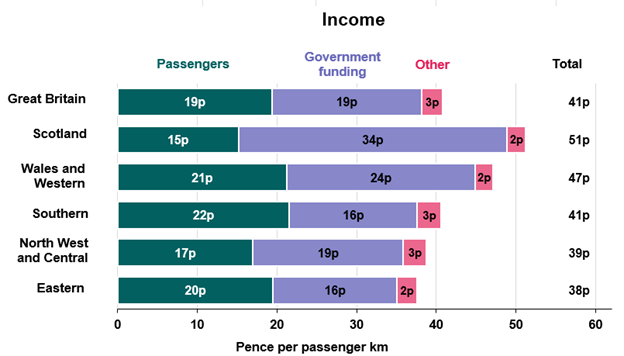
The rise in fare revenue contributed to a reduction in funding from the UK and devolved governments towards the operation of the railway. This fell to £11.9 billion in the year, down £0.9 billion from the previous year. Our statistics show that passengers in Scotland received the highest level of government support per passenger kilometre travelled compared with other regions.
Sources of industry income and government funding of the operational railway Great Britain, April 2024 to March 2025
ORR’s Rail Industry Finance (April 2024 to March 2025) statistics provide a breakdown of income, expenditure and government funding for the UK rail industry. The key findings include:
- Fares income is up year-on-year: Fares income was £11.5 billion, up 8% (£0.9 billion, adjusted for inflation) with fare income from regional journeys seeing the highest growth (11%).
- Despite this, overall industry income is slightly down: The industry as a whole received £25.9 billion of operational income in the latest year, a decrease of 1% (£151 million, adjusted for inflation).
- Expenditure is up: Operational industry expenditure increased by 1% to £26.0 billion. Excluding financing costs, expenditure was £23.5 billion, 2% higher than the previous year.
- Government funding reduced: The UK and devolved governments contributed a total of £11.9 billion for the day-to-day operation of the railway which is nearly half (46%) of the industry’s income.
- HS2 represents the majority of current railway investment: Investment in new and enhanced rail infrastructure and rolling stock reduced to £10.3 billion, down 4% (£0.4 billion) on the previous year. Most of this was invested into High Speed 2 (HS2) at £7.1 billion.
- Private investment increased: Private companies invested a total of £756 million in the rail industry during the year. An increase of 27% (£161 million) on the previous year.
- Dividends: 10 out of 20 public contracted train operators were expected to pay dividends totalling £164 million, down 3% on the previous year. Publicly owned operators accounted for 12% of this total.
- Rolling stock leasing: Net profit margins of rolling stock companies (ROSCOs) decreased 3 percentage points to 19%. ROSCOs paid £275 million in dividends to shareholders, a reduction of 19% (£64 million) compared with the previous year.
Will Godfrey, Director of Economics, Finance and Markets yesterday said:
“Taking stock of the national rail finances in our annual report, we welcome the continued recovery in fares income in the last year. But cost pressures and a lagged recovery in industry income compared to passenger journeys, explains why the reduction in government funding still leaves the overall subsidy substantially above pre-pandemic levels.”
Original article link: https://www.orr.gov.uk/search-news/increasing-fares-revenue-contributes-reduction-government-subsidy-railways