Met Office
 Printable version Printable version
|
Operation Blue Skies: advancing weather intelligence for aviation
Aviation is a mainstay of modern life, connecting people, businesses and communities across the world. As the sector works towards reducing its environmental impact, weather and climate science have an important role helping to unlock practical, evidence-based actions to lower the sector’s climate change contribution.
As a long-standing provider of weather services to the aviation sector, the Met Office is supporting Operation Blue Skies: a major UK-led research programme exploring how weather intelligence can identify atmospheric conditions associated with persistent aircraft contrails, which can add to climate change.
What is Operation Blue Skies?
Operation Blue Skies is the world's first large-scale oceanic airspace-trial focused on contrail avoidance. Led by Google UK and supported by the UK Government through the Aerospace Technology Institute (ATI) Programme - the project brings together organisations from across aviation, academia and atmospheric science.
Supported by the Department for Transport, and comprising NATS, Google, the University of Cambridge, Imperial College London and the Met Office as a subcontractor for contrails.org, the programme will test whether small changes in an aircraft’s altitude can help avoid atmospheric conditions favouring the development of persistent warming contrails.
The operational trials will take place over selected periods during the winters of 2026/27 and 2027/28 within the Shanwick Oceanic airspace over the eastern North Atlantic.
The Met Office is providing meteorological expertise, including the development of a contrail impact forecasting capability, and support for scientific evaluation throughout the trial.
Understanding condensation trails
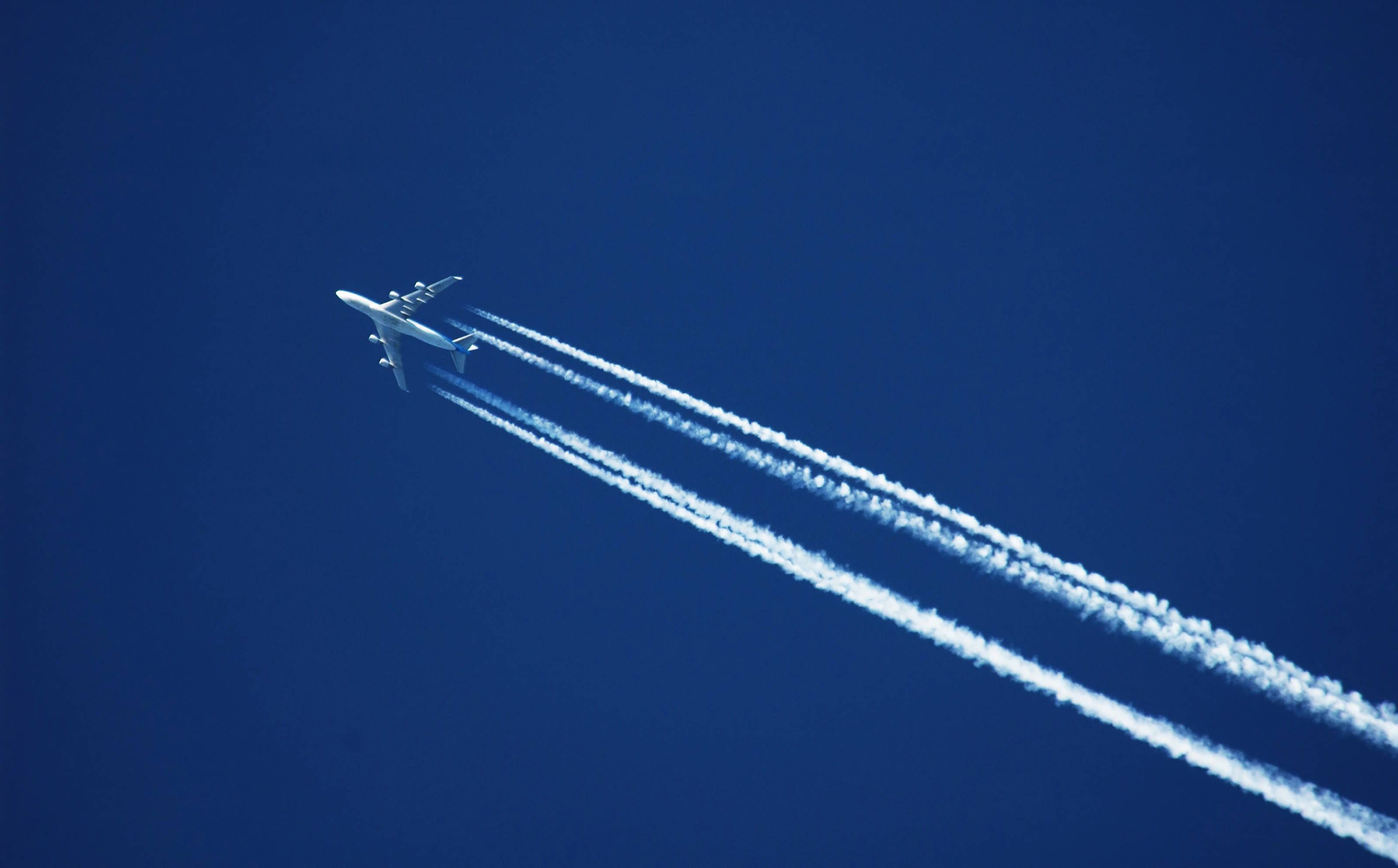
Condensation trails, or ‘contrails’, form when water vapour from an aircraft’s exhaust mixes with very cold air in the upper atmosphere. Under the right conditions, the water vapour freezes into tiny ice crystals, creating a visible cloud-like trail.
Contrails are a well-understood atmospheric phenomenon that have been observed and researched for many decades. They are formed by aircraft operating in certain temperature and humidity conditions, in much the same way as clouds form naturally when water vapour condenses and freezes in the atmosphere. Their occurrence and persistence are determined by the surrounding weather conditions.
Not all contrails behave in the same way. Some disappear within a few minutes, while others can persist for several hours and spread out into larger cloud formations.
Whether a contrail forms, and how long it lasts, depends on the weather conditions at cruising altitude, particularly the temperature and humidity of the surrounding air.
This means two aircraft flying at slightly different heights may experience very different conditions; with one creating a persistent contrail, while the other does not.
Why are scientists interested in persistent contrails?
Like naturally-occurring clouds, contrails interact with energy entering and leaving the atmosphere. They can reflect some incoming sunlight back into space, but they can also trap heat that would otherwise escape from the Earth's surface.
Research suggests that, in many situations, the warming effect outweighs the cooling effect, meaning some persistent contrails contribute to overall climate warming.
Importantly, these effects depend strongly on the atmospheric conditions present at a particular time and location. This is why improved forecasting is a key area of scientific interest.
If weather models can reliably identify regions where persistent contrails are more likely to form, there may be opportunities for aircraft operators and air traffic managers to make small operational adjustments while maintaining safe and efficient flights.
The Met Office's role
As the UK's national meteorological service and a long-standing partner to the aviation sector, the Met Office brings extensive expertise in weather forecasting, atmospheric science and operational aviation support.
Our contribution to Operation Blue Skies includes:
Developing a new contrail impact forecasting capability
Met Office scientists are developing a global contrail impact forecasting capability to identify atmospheric regions where persistent contrails may form.
This builds on our world-leading numerical weather prediction capability and expertise in understanding the upper atmosphere.
Supporting aviation operations
Our meteorologists already provide operational weather services supporting safe and efficient air traffic management. Through teams working closely with NATS, we will provide meteorological expertise to support planning and operational decision-making during the trials.
Scientific assessment and validation
Met Office experts will support the evaluation of forecast performance and scientific assessment of trial outcomes, helping to ensure that results are scientifically robust and that uncertainties are properly understood.
How the programme is funded
Operation Blue Skies is a £5 million programme funded by the UK Government through the Aerospace Technology Institute (ATI) Programme. Government funding is provided through the Department for Transport's Jet Zero R&D Programme, delivered via the ATI Programme in partnership with the Department for Business, Innovation, Science and Trade (BIST) and Innovate UK.
The programme forms part of wider UK research into aviation's non-CO₂ climate impacts and brings together expertise from government, industry and researchers to investigate innovative ways of reducing aviation's contribution to climate change.
Building on our support for aviation
Operation Blue Skies is a natural extension of the Met Office's long-standing support for the aviation sector.
Emma Corrigan is an aviation expert at the Met Office. She said: “Every day, our forecasts help airlines, airports, air traffic controllers and pilots make informed decisions. Through this programme, we are exploring how those same weather and climate science capabilities could help address environmental challenges for aviation.”
Contrail avoidance supplements wider efforts to reduce aviation's environmental impact. Sustainable aviation fuels, aircraft efficiency improvements and future propulsion technologies will all be important parts of the sector's long-term transition.
However, Operation Blue Skies will help improve understanding of whether weather-informed operational decisions can provide an additional way to reduce climate impacts.
Looking ahead
The first operational trial period is scheduled for winter 2026/27, with further testing planned for winter 2027/28.
By bringing together weather intelligence, operational expertise and scientific research, Operation Blue Skies represents an important opportunity to better understand how forecasting can support aviation's journey towards a lower climate impact.
James Shapland, Head of Regulated Transport Services at the Met Office, said: “As a key partner to the aviation industry, we are pleased to bring our trusted weather intelligence and sector expertise to this programme. Our understanding of regional weather regimes will provide an important scientific basis for the trials, and developing a global contrail forecast capability aligns with our strategic work to support the aviation industry in managing its longer-term environmental impacts.”
About this blog
This is the official blog of the Met Office news team, intended to provide journalists and bloggers with the latest weather, climate science and business news, and information from the Met Office.
Original article link: https://www.metoffice.gov.uk/blog/2026/operation-blue-skies-advancing-weather-intelligence-for-aviation-