.png "Executive AI Leadership Programme for the UK Public Sector")


RUSI
 Printable version Printable version
|
Starmer Shows his Hand on Defence Spending
The increase in UK defence spending announced on 25 February has been welcomed by many, but the focus on fractions of a percent must not be a distraction from the real issue of output and generating armed forces capable of being a credible deterrent to aggression.
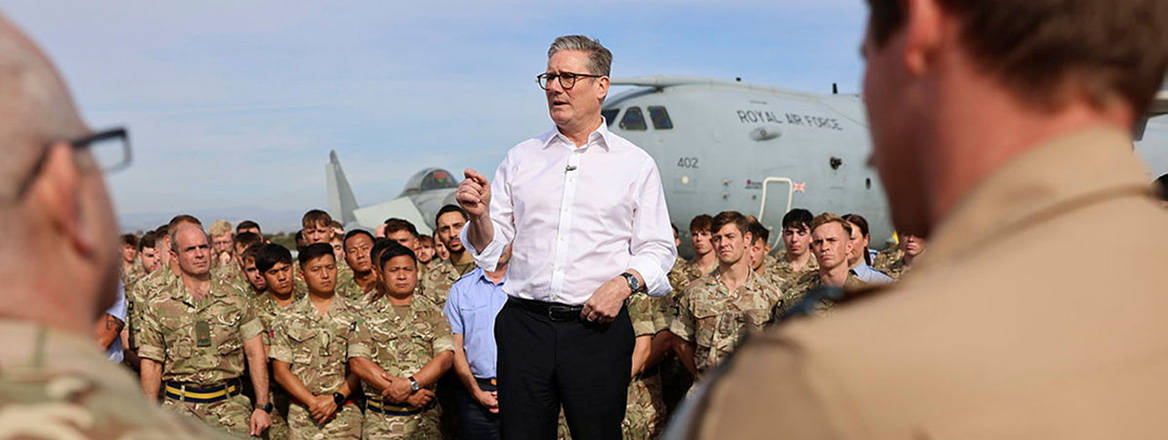
Standing up in the House of Commons on 25 February, Prime Minister Keir Starmer finally met his manifesto commitment to 'set out a pathway' to spending 2.5% of GDP on defence, stating that this would be achieved by 2027, sustained throughout the rest of this Parliament and followed by an ambition to reach 3% during the course of the next Parliament. The statement was welcomed by the House, but accompanied by questions as to whether this would be ‘enough’, something that has been a topic of debate for several months given the state of the Armed Forces and with the
Strategic Defence Review (SDR) underway. The prime minister’s statement was clearly intended to pave the way for his visit to Washington, given the new US administration has made the case that for Europe to do more it should be spending 5%.
Calculating 2%
The obsession with defence spending expressed as a percentage of GDP is a long-standing spectator sport within NATO, and the current focus extends back to the 2014 NATO Summit in Wales, where the Allies agreed to keep spending at that level as a minimum, or to move towards it within a decade – all with an aim of meeting NATO capability goals. The problem is that as a headline, the target is a political statement of intent, and it is often forgotten that the capability goals and commitments towards NATO are the actual measure of success. The current focus on percentage figures as a test of political virility risks obscuring the fact that what NATO and Europe in particular require are credible armed forces capable of fighting and winning, such that they deter an adversary from even attempting to use force. Meeting 2.5% will not be ‘enough’ to help UK defence if it becomes the goal in its own right, nor will 3% or any other suspiciously round number apparently plucked from the air.
Image credit: House of Commons Library
Any percentage figure can be problematic because the NATO criteria make clear they are quite broad, and can include costs that might not be related to direct military output. Some portion of the budget for the UK’s intelligence agencies (the Single Intelligence Account) has often been included in defence spending: many military personnel are seconded to the agencies, especially for signals intelligence and cyber activity as part of the National Cyber Force. In his statement, the prime minister appeared to suggest that a greater proportion (of what was £4.2 billion in 2024/25) would be counted as defence spending in the future, bringing the current percentage to 2.6%. This was justified as a response to the ‘changing nature’ of the threat, but it will need to be subject to some scrutiny in the future if there is further pressure within the Ministry of Defence (MoD).
The current focus on percentage figures as a test of political virility risks obscuring the fact that what NATO and Europe in particular require are credible armed forces capable of fighting and winning
The UK’s relationship with the 2% figure has been fraught; in a worrying example of inconvenient timing, the cuts to defence spending after the 2010 Strategic Defence and Security Review risked taking the UK below the 2% threshold around the Wales Summit. As the Commons Defence Committee identified a few years later, this fate was avoided by including some items (allowed under the NATO criteria) in defence spending which had previously not been used. It is worth remembering that the criteria aren’t just calculated against the core defence budget, and that other spending such as the cost of operations drawn from the Treasury Special Reserve can also be included. Figures in the current government who point out that the UK last hit 2.5% around 2009 and 2010 would do well to remember that was because Special Reserve funding going towards the considerable cost of simultaneous operations in Iraq and Afghanistan was included. Today, the annual commitment of £3 billion for Ukraine, which covers purchasing equipment, training Ukrainians and the cost of some operations in Europe, also comes from the Special Reserve. This isn’t unreasonable: it is still defence spending, but it is another example of why the 2.5% figure can’t be used as a measure of UK core military capability or outputs.
Click here for the full press release
Original article link: https://rusi.org/explore-our-research/publications/commentary/starmer-shows-his-hand-defence-spending
.jpg "Local government reorganisation (LGR)")


