techUK
 Printable version Printable version
|
India AI Impact Summit: Day 4
Day 4 marked the high-level leaders' plenary and CEO roundtables at the AI Impact Summit, with the main summit closed to invited guests only. Overall it was a day of diplomatic engagement, major announcements, and an evening celebration of UK leadership in the global AI conversation.
Throughout the day, the UK’s Deputy Prime Minister David Lammy MP took several media interviews in the UK pavilion, discussing UK-India relations, the UK's role in the global AI ecosystem, and the strength of UK businesses operating at the frontier of AI innovation. The visibility of senior UK government figures at the summit reinforced the UK's commitment to being a leading voice in shaping inclusive, responsible AI governance on the world stage.

The evening brought one of the summit's standout moments: a reception at the British High Commissioner's residence. The event opened with remarks from UK AI Minister Kanishka Narayan MP, before a fireside conversation between former past UK Prime Minister Rishi Sunak and Deputy Prime Minister David Lammy MP. The discussion explored the UK-India relationship, the opportunities for deeper collaboration in AI and technology, and the importance of ensuring AI development serves shared democratic values and economic ambitions. It was a powerful reminder of the depth of the UK-India partnership and the strategic importance both nations place on AI cooperation.
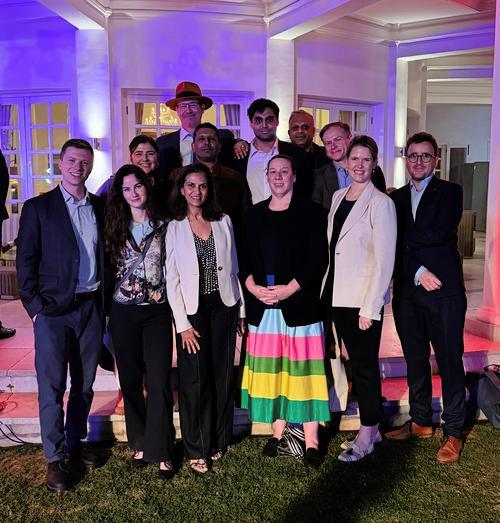
The evening continued with "AI Talks," a series of five-minute TEDx-style presentations showcasing innovation and thought leadership. The techUK delegation cheered on three of our UK representatives taking the stage: Tim McGarr of BSI, James Winters of Colt, and Ayan Ghosh of Fior Group. Each delivered compelling insights in front of an international audience, highlighting the breadth and quality of UK expertise in AI standards, infrastructure, and investment.
Away from the stage, the day also saw the release of a significant piece of work: a joint outcome report from techUK and UKAIBC, following up on our UK-India Policy Exchange on AI & Technology Cooperation Roundtable held on 30 January 2026 in New Delhi. The roundtable brought together over 50 stakeholders from government, industry, academia, and philanthropy, both virtually and in person, to enhance collaboration between the UK and India on inclusive and responsible AI governance. The report, printed versions of which were shared at the UK pavilion, will officially go live next week.
The report builds on the momentum from the Bletchley Park AI Summit in 2023 and the Paris Summit in 2025, exploring synergies between UK and Indian approaches to AI regulation and governance. Two interactive sessions shaped the discussion: the first focused on developments under the UK-India Technology Security Initiative (TSI) and the Comprehensive Economic Partnership Agreement (CETA), alongside AI case study experiences from participants. The second session looked ahead, with participants sharing insights on encouraging private investment in AI, enhancing ease of doing business and investor protection, promoting regulatory alignment, advancing AI research and development, and raising advocacy concerns and concrete actions to inform the AI Impact Summit.
The report underscores the strategic importance of the UK-India partnership. As the world's sixth and fourth-largest economies respectively, both nations recognise that the transition into the AI economy represents one of the most significant industrial transformations of the 21st century. The Prime Ministers of India and the UK reaffirmed this shared commitment in October 2025, building on the progress of the TSI and the innovation chapter of the UK-India FTA (CETA), which facilitates the mobility of Indian professionals across 35 service sectors. Both countries have also committed to international cooperation on AI safety, with the UK coordinating an international coalition of AI Safety Institutes and India announcing the establishment of its own Artificial Intelligence Safety Institute (AISI).
A major development on Day 4 came from the Indian government itself. Union IT Minister Ashwini Vaishnaw unveiled the 'New Delhi Frontier AI Commitments' which is a voluntary framework adopted by leading global and Indian AI firms. Calling it a "significant outcome" of the summit, Minister Vaishnaw said, "Today, leading frontier AI companies along with our own AI companies have come together to make a set of voluntary commitments a shared commitment for inclusive and shared AI."
He outlined two central commitments under the initiative. The first is advancing real-world AI usage through anonymised and aggregated insights, which Vaishnaw said would "support evidence-based policymaking on jobs, skills and policy making." The effort is expected to help governments and institutions better track employment trends and evolving skill requirements while maintaining privacy safeguards. The initiative reflects a common vision among global AI leaders and Indian innovators to ensure that AI development remains responsible, inclusive, and beneficial for society.
As Day 4 drew to a close, the combination of high-level diplomacy, policy outputs, and the visible strength of the UK-India partnership underscored why this summit matters. The conversations are no longer just about what AI could do, they're about what we will do, together as we move forward.
Original article link: https://www.techuk.org/resource/india-ai-impact-summit-day-4.html