RUSI
 Printable version |
Operation Rummy: Franco-British Nuclear Cooperation Strengthens European Deterrence
Operation Rummy, the first joint Franco-British nuclear air exercise, deepens bilateral deterrence and offers a template for wider European nuclear cooperation.
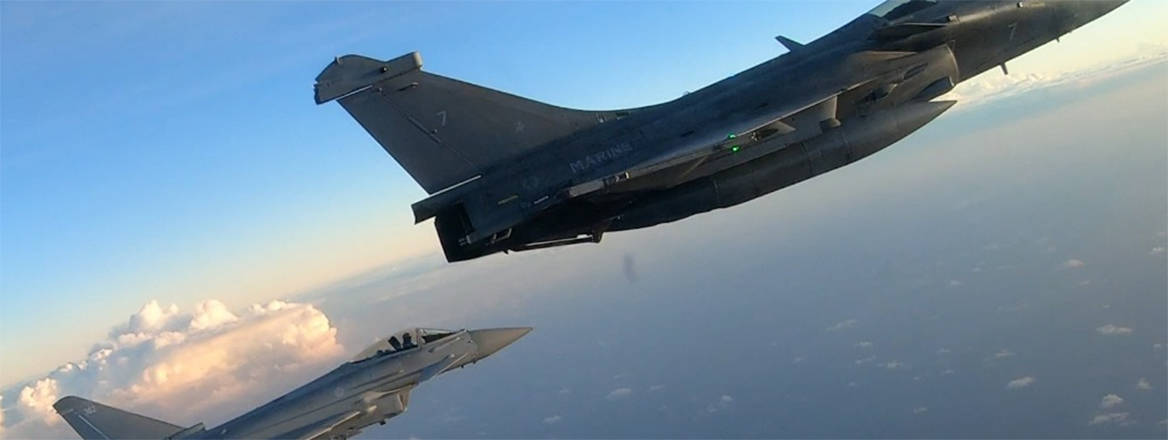
On 20–21 October, the Royal Air Force and France’s Strategic Air Forces (Forces aériennes stratégiques, or FAS) conducted a joint nuclear exercise, marking a noteworthy advance in Franco-British cooperation on nuclear deterrence. The mission – dubbed Operation Rummy – saw British Eurofighter Typhoons escort French Rafales from the Saint-Dizier airbase in northeastern France to the Mediterranean Sea for a simulated long-range nuclear strike mission. The exercise was a step forward in the operationalisation of the 2025 Northwood Declaration, under which France and the UK committed to closer nuclear cooperation and coordination. It has also had the benefit of allowing the UK and France to signal their respective and joint commitments to European nuclear deterrence more broadly – which has thus far posed some challenges. The next step will be figuring out how to bring the various nuclear cooperation efforts underway in Europe together, so as to maximise their effectiveness and clarity.
Benefits to Bilateral Nuclear Cooperation
Operation Rummy follows earlier attendance by British officials at France’s Operation Poker nuclear exercise in December 2025. The active participation of British aircraft this time around is a valuable – and much awaited among the expert community – demonstration of the French and British intent to use the Northwood Declaration for meaningful engagement, not just political signalling.
The joint exercise reinforces a sense of shared British and French threat perception and signals – to adversaries as well as allies – a progressively advanced level of strategic and operational coordination on nuclear matters between the two countries. In a real-world scenario, escorting a French nuclear strike would implicate the UK as a key enabler for the attack, thereby making it a target for retaliation. By playing out such a contribution in training, London has therefore demonstrated an ability – as well as a potential willingness – to serve in such an enabler role and to bear the associated risks. In fact, British Typhoons could make an important contribution to a French nuclear operation in what the French call an épaulement (conventional support) role, given their particular suitability to Defensive Counter Air operations.
Considering that France holds sacred the independence and self-sufficiency of its nuclear deterrent, it remains unclear to what extent the FAS would be willing to rely on foreign enablers for a real-world nuclear mission, or just how far Paris would be willing to take cooperation in practice. However, Operation Rummy is an encouraging indicator of a broader willingness in both Paris and London to think ambitiously about possible avenues for a further expansion of Franco-British nuclear collaboration and cooperation. This could – in theory – take a variety of forms, including more complex joint exercises or even eventual joint nuclear planning and targeting (though the latter remains a remote prospect for the time being).
A desire to avoid the perception that forward deterrence might compete with US extended deterrence by replicating NATO-style nuclear coordination outside of NATO structures will also limit France’s ability to bring the various bilateral conversations together, limiting the effectiveness and ambitions of the initiative
For the UK, closer engagement between the RAF and the FAS also presents valuable learning opportunities as the RAF gets ready to return to a nuclear role with NATO’s DCA (dual-capable aircraft) mission. Unlike the FAS – which carry sovereign French nuclear weapons – the RAF would be delivering American B61 bombs as part of a wider NATO mission, commanded by SACEUR (Supreme Allied Commander Europe). As such, the two air forces’ nuclear roles will be very different. Nevertheless, there is room for meaningful exchange on a range of matters, including effective force management to account for both conventional and nuclear mission requirements, as well as considerations relating to personnel training and broader cultural aspects necessary for effective nuclear mission delivery. Should the UK decide to eventually consider a return to a sovereign air-launched capability (for now, still an academic discussion), experience gained through engagement with the FAS will become even more relevant.
Original article link: https://www.rusi.org/explore-our-research/publications/commentary/operation-rummy-franco-british-nuclear-cooperation-strengthens-european-deterrence