.jpg "Local government reorganisation (LGR) Hub")


RUSI
 Printable version Printable version
|
The Overstretch Facing the US Navy
The US is exceeding its own plans for deployment of aircraft carriers, and the knock-on effects, and the strain, should be a cause for concern.
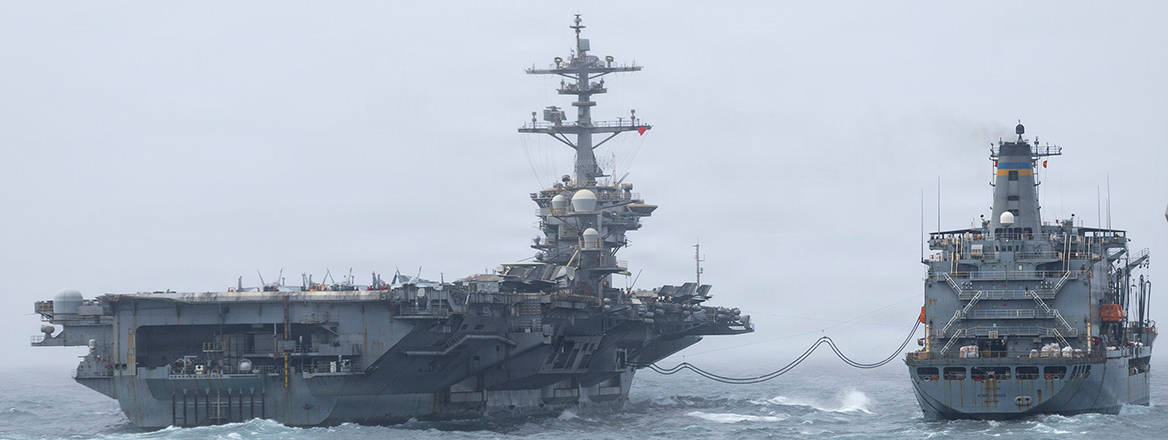
In the late 1990s the political scientist Samuel Huntington described the emergence of a ‘uni-multipolar’ world in which the US would be stronger than any major regional power yet might sometimes have less available regional capacity than many of them. Though some way off at the time of Huntington’s writing, this reality may now be upon us. Nowhere is this more apparent than in the maritime domain where the US Navy remains globally dominant and yet seems to have less capacity in most key regions than it would like.
USS Abraham Lincoln has hit the headlines because it was deployed for over 270 days – almost nine months, most of them in the Middle East. The US Navy’s standard deployment length is around seven months, or 210 days. More worryingly, the length of the Lincoln deployment is neither a one-off, nor is it a record. That dubious honour goes to USS Gerald R Ford which completed a 326-day deployment earlier this year. This has now become a trend, rather than an exception. Based on US Navy press releases over the last decade, it can be established that of the 11 carrier deployments since 2023, eight have lasted for eight months or more, and five have been at least nine months.
On paper the US Navy has 11 aircraft carriers, and will soon have only ten, as USS Nimitz is retired. It might sound like a lot, and it is in comparison to the rest of the world, but it takes considerable effort to keep just one on station. In principle, deployment schedules should be determined by the US Navy's Optimized Fleet Response Plan, its force generation planning model for deployments and rotations. The plan assumes a three-year cycle for each carrier based on a seven-month deployment, with the remainder made up of maintenance, training, leave, and a period at high readiness. That means that at any given time, the US Navy should expect to have two or three carriers deployed and the rest at some other point on the generation cycle. If a deployment then stretches to nine months, or ten or eleven, the maintenance requirements will usually be longer. This, in turn, has an impact on the rest of the cycle and a knock-on effect on the availability of maintenance facilities for other vessels.
Click here for the full press release
Original article link: https://www.rusi.org/explore-our-research/publications/commentary/overstretch-facing-us-navy