.jpg "Local government reorganisation (LGR) Hub")


RUSI
 Printable version Printable version
|
Checkmate? Russian Orbital Manoeuvring Threatens Ukraine’s Space Capability
With unclear intention, Russia’s satellites have been placed curiously close to a commercial satellite that provides essential intelligence for the Ukrainian armed forces.
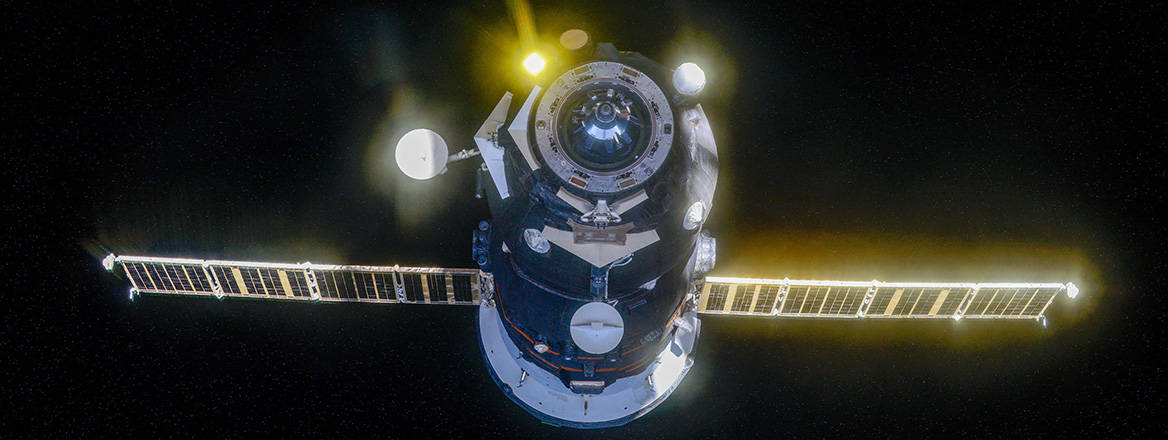
In late May, four Russian military satellites adjusted their position to match the orbital plane of the commercial radar reconnaissance satellite ICEYE-X36. The Russian satellites were declared to be for military purposes and launched in April 2026, with their exact capabilities unknown. The seemingly targeted ICEYE satellite is not just any commercial radar satellite – it is the ‘People’s Satellite’, a Synthetic Aperture Radar (SAR) satellite from the Finnish company ICEYE whose data services were purchased through Ukrainian fundraising in 2022. An orbital plane matching manoeuvre is costly and the positioning of four satellites at once seems highly intentional. The question is: why would Russia perform such a manoeuvre and what are the possible motives?
Possible Motive One: Intimidation
Russia is no stranger to intimidation tactics, either on the ground or in space. Concealing manoeuvres in space is tricky to do and satellites can usually be identified – all alien puns aside, there is little risk of ‘little green men’ in space. However, very often the on-board capabilities of a satellite cannot be gleaned from the outside – unless external indicators, such as sensors, can be seen.
The type of manoeuvre as conducted by Russia can appear threatening because of what this could be a precursor to: the way in which the Cosmos satellites are currently positioned, a rendezvous and proximity manoeuvre (RPO) could be conducted with relatively little warning. RPOs can be conducted for a number of reasons, such as getting close enough to photograph a satellite to gauge its potential capabilities, or to intercept/listen into signals being sent to and from the satellite. These signals can also be interfered with and disrupted. Further, satellites could be physically harmed.
Part of the intimidation motive could have been to spook the operators sufficiently to move the satellite – a move that would adjust its coverage area (currently set to support Ukrainian Armed Forces as best as possible) and to further expend costly fuel. However, ICEYE-X36 does not appear to have moved.
The physical destruction or even interference of a satellite would cross a red line that Russia (and in fact, no other space actor) has previously crossed
It seems unlikely that Russia would use four brand-new satellites and use vast amounts of their on-board fuel simply for the sake of intimidation. The fuel aboard a satellite dictates its lifetime and is essentially the currency of space operations. ‘Wasting’ it on a political objective thus seems disproportionate. The Cosmos satellites could also be one-way satellites with a singular mission. However, the cost of this again speaks against intimidation alone as a goal. Especially since Russia’s space industry is in dire straits. This points to other potential reasons.
Original article link: https://www.rusi.org/explore-our-research/publications/commentary/checkmate-russian-orbital-manoeuvring-threatens-ukraines-space-capability
.jpg "Local government reorganisation (LGR)")


