RUSI
 Printable version Printable version
|
The Inextricable Link Between Geopolitics, Security and Humanitarian Impact
As big as the change at the end of the Cold War, the current 'hinge moment' is different in its complexities, discusses former UK Foreign Secretary David Miliband.
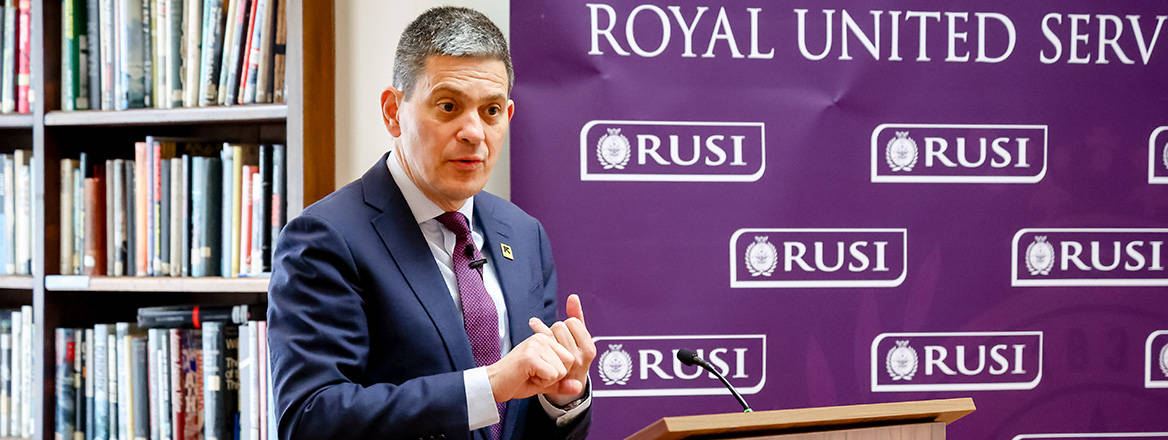
I am often asked about the difference between being Foreign Secretary and leading a humanitarian organisation. The truth is that in government, you are constantly confronted by the big picture. But the danger is that you lose sight of the people. In an NGO, you are confronted every day by the people you serve. But the danger is that you can lose sight of the big picture. Amid ongoing debates over the role, scope and impact of aid, we have to acknowledge both the macro and micro, the geopolitical shifts reshaping the world and the clients of organisations like the International Rescue Committee (IRC) who live at the sharp end of any policy decision.
A Hinge Moment
This is a hinge moment in international affairs. A moment at least as big as the end of the Cold War in 1989/90. The geopolitical order is changing in fundamental ways.
First, multi-alignment. The world is moving away from a system dominated by a small number of powers toward a far more multi-aligned order with many more centres of influence. In the early 1990s, the G7 accounted for more than half of global GDP at purchasing power parity. Today it represents roughly a quarter of the world economy. Economic, political and technological power have all dispersed.
Countries no longer line up neatly behind a single hegemon or bloc, or even two. Governments are balancing relationships, hedging risks and aligning issue-by-issue. Regional powers exercise greater influence. Middle powers possess greater strategic flexibility. State and non-state actors can wield disproportionate influence. The superpowers are super-powerful, but they do not always get their way. And sometimes they get in their own way.
For humanitarians, the consequences are severe. Countries already in conflict, like Sudan, become arenas for regional competition, with outside powers fuelling and prolonging the violence. At the same time, the international consensus – that once set a benchmark for protection of civilians or humanitarian access – has weakened. Diplomatic coordination has frayed as well, making it harder to build the political pathways needed for peace.
Second, the role of the US as the anchor of the international system has changed fundamentally. The period after the Second World War was remarkable for several reasons. A Cold War with the hot threat of nuclear annihilation was unprecedented. But there was something else. The US, as the most powerful country in the world, made lots of mistakes. But it anchored the global system not just as the reserve currency, but as the largest aid donor, a diplomatic force all over the world, an indispensable power.
Click here for the full press release
Original article link: https://www.rusi.org/explore-our-research/publications/commentary/inextricable-link-between-geopolitics-security-and-humanitarian-impact